Latest Reviews

Mostrando entradas con la etiqueta 1990s. Mostrar todas las entradas

miércoles, 24 de octubre de 2012

'The Sixthe Sense' (M. Night Shyamalan, 1999)


Title: 'The Sixth Sense'

Release Year: 1999

Director: M. Night Shyamalan

Cast: Bruce Willis, Haley Joel Osment, Toni Collette.

Plot: After being shot by a former patient whom he couldn't help as a child, child psychologist Malcolm Crowe tries to amend his mistakes with his new terrified and confused patient, Cole Sear, who in whispers confesses him that he sees dead people.

Review: There's something you must know before I review 'The Sixth Sense'. A couple of years ago, after I said to my sister I wanted to watch 'The Others' (which I had read had a similar ending to 'The Sixth Sense'), she "accidentaly" spoiled me the ending. So making a simple connection, I knew from the very beginning that Willis was dead. I had forgotten it over time, but when Willis is shot at the beginning of the film, the memory just appaeared in my mind.

This way, I saw the movie quite differently. It's like I had watched it for the first time and then, knowing that Malcolm was dead, rewatching it to see how they managed to never show his bloody back, to make the audience forget that he always eats the same, or that he never changes his clothes. And somehow, I also enjoyed that way of watching the film. Anyway, there are several hints that are too big not to see them, even if you don't know the ending, how do you explain that Malcolm never exchanges a word with anyone except Cole? And, most important, when the kid confesses his gift, he adds 'They don't know they're dead'. Isn't it clear enough!?

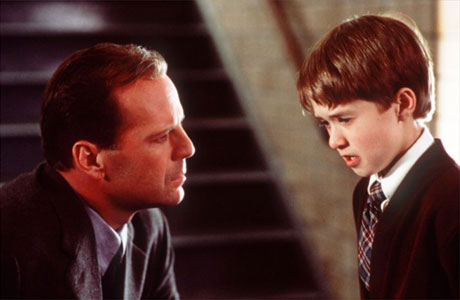
Malcolm and Cole have a troubled yet endearing relationship

Leaving that behind, you start to understand why Cole says that Malcolm can't help him if precisely it's from appearances like his from what he's escaping. Then you ask yourself why he didn't tell him. I believe that Cole had such a kind heart that he didn't want to break the man's illusion, waiting for him to discover it by himself and accept it (as he does when Cole suggests that he 'talks to his wife while she's sleeping'). The relationship between these two characters is really based on mutual understanding and support. Cole helps Malcolm discover his death and Malcolm contributes to Cole's acceptance of his gift, not as a scary curse but as a possibility to help people who left unfinished businesses in earth (like the girl who was poisoned by her mother).

Cole is constantly visited by dead people ghosts who are looking for help

Finally, the performances are top-notch. Willis does a remarkable leading performance, but it's the young Haley Joel Osment who shines the most. Thanks to him the movie is not only a consequence of screams but a real tale of despair of a poor boy who thinks that he's turning insane, constantly visited by dead people that torture him. The final scene with his mother (an outstanding Toni Collette) is the heartbreaking ultimate reunion of the detached little family. She finally understands that her son's claims to see and listen to dead people are true when he says to her that the answer to her question to her dead mother is 'every day'. Lynn (the mother's name) confesses tearfully that the question is 'Do I make you proud?' This way the film ends, leaving an atypical feeling; a horror movie with a heart and a sensitive ending.


'I see dead people' Haley Joel Osment did an incredible performance in this movie. Two thumbs up; he knocks it out of the park in the film

martes, 23 de octubre de 2012

'Titanic' (James Cameron, 1997)


Title: 'Titanic'

Release Year: 1997

Director: James Cameron

Cast: Leonardo DiCaprio, Kate Winslet, Billy Zane, Frances Fisher, Gloria Stuard, Bill Paxton, Suzy Amis, Kathy Bates.

Plot: In the short-lived Titanic, a love story blossoms between the members of two social classes, fighting against the odds and the terrible disaster that awaits them.

Review: I have a problem with Titanic: once I start talking about it, I can't stop. I've seen the film like 10 times (complete) and once in a while I review some of my favourite scenes. The last time I saw the whole length was when I went to the cinema to watch the 3-D version (an absolute waste of money
-Moreover, I think that I'm unable to watch 3-D imagery...-) and I spent 2 weeks crying in my house, asking why Jack had to die. Yes, as it might be obvious, Titanic is my favourite movie.

Rose and Jack famous kissing scene

There is an important gap, though, between the first times I saw the film and the later ones. In the beginning I remember loving the film due to its tragic ending (I think I've missed the beginning of Titanic like 5 times when they showed it on TV), but I didn't especially pay much attention to the rest of the movie (or I don't remember it, I was quite young). The first time I saw it as a teenager, the situation changed; I loved EVERY SINGLE PART of the film. Not only did I cry like Mary Magdalane did when Jesus died, but I worshipped the relationship of Jack and Rose up to unimaginable points.

The dancing scene in a third class party is one of my favorite ones

The dancing scene is one of my favourites from their little adventure together (excluding the final, that's the favorite one above all), but I have tons and tons of videos, images and gifs collected and even deleted scenes (did you know that there's a second version to the ending? You can watch it here). My addiction to Titanic goes far beyond what's normal. But if I have the chance to excuse myself, the film is to blame for it; groundbreaking visual effect (early digital edition executed to perfection, which brought the budget of the movie to the then unthinkable $250 million), a marvelous score, led by the beautiful voice of Celine Dion singing 'My Heart Will Go On', the dramatic collision of the iceberg agains Titanic and the unfair death of Jack.


As Rose whispers 'Come Josephine', Jack dies in a heartbreaking scene. I still can remember her saying 'There's a boat Jack!' and not receiving any answer. One of the most remembered scenes together with the drowning and the 'You jump I jump' ones. Excuse the poor quality but every higher quality version has been deleted from YouTube due to copyright infringements

That final scene with Rose at the top of a floating door and Jack frozen in the water (both fit on top, but the weight would have drowned the fragile structure) is heartbreaking and it's followed by the 'A woman's heart is an ocean full of secrets' scene. After that moment, I was an ocean full of tears and Titanic became the best movie I had ever seen.

Tearful 'Titanic' ending

lunes, 22 de octubre de 2012

'The Shawshank Redemption' (Frank Darabont, 1994)


Title: 'The Shawshank Redemption'

Release Year: 1994

Director: Frank Darabont

Cast: Tim Robbins, Morgan Freeman.

Plot: Andrew Dufresne is sent to prison to fulfill a penal servitude for life after he's condemned for the murder of his wife and her lover. After years of imprisonment he gains the trust of the prison headmaster and the respect and admiration of his prison mates, especially Red, the 'one who gets what you want in prison'.

Review: If you're a moviegoer, you'll know that the condemned-man-breaks-free plot is quite common in American cinema, maybe because it's powerful and reaches one of the most beloved topics in film industry: freedom. Anyhow, 'The Shawshank Redemption' is not only a smartly planned leak from prison, it's a real personal journey for its leading characters.

Marvelously cast, Andrew and Red become friends after some time in prison. Freeman's Red, the narrator, quickly feels a secret admiration for him and his quiet behaviour. Many critics said that the fact that Dudresne seems all the time detached from everything didn't contribute to the audience's connection with the film, but I personaly found his performance impressive and raw. Moreover, his character is smart and clever, and responsible for the major plot twist in the film; his escape unfolds so incredibly that the audience is left baffled observing the poster of Raquel Welch. When after crawling for hundreds and hundred of meters of crap he finally reaches the water and liberates himself, any detached member of the audience must feel connected with the character, in a powerfully emotional scene, a symbol of his success over the tyranny imposed by the prison's headmaster, a corrupt character whose moment to pay arrives later in the movie thanks to the visionary mind of Dufresne.


As the marvelous score sounds, Dufrasne escapes from prison in this beautiful and wonderful scene

The other main topic in the film is the belonging to the prison, the fact of being 'institutionalized'. When Brooks is set free almost fifty years after he was condemned, he must return to an unknown and changed society (he entered at the beginning of the 20th century and goes out in 1954) where he feels he has no place or recognition (unlike in prison, where he was considered an educated man) and ultimately kills himself, but hanging from a beam, after writing 'Brooks was here'. The same situation happens when after years of questionnaires they let Red go. He starts to understand Brooks as he feels too old for a society where he no longer belongs and, the same way that he suffered for the possibility of Andrew killing himself for so many years of unfair imprisonment, the audience starts fearing the worst. But his time, Drufrasne is there to help him; he visits the location that he indicated him once to go if he ever was freed and there he finds (as Andrew had planned) money and a letter to join his friend in Zihuatanejo, a Mexican Pacific coastal town, which he ultimately does, writing 'So was Red' next to the message left by Brooks and violating his parole. At the end, both friends reunite as they hug each other in an emotional ending.


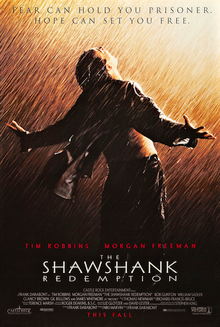
The friendships of Andrew, connected in prison through the years, is what leads the movie from its beginning to the very end

domingo, 21 de octubre de 2012

'Pulp Fiction' (Quentin Tarantino, 1994)


Title: 'Pulp Fiction'

Release Year: 1994

Director: Quentin Tarantino

Cast: John Travolta, Samuel L. Jackson, Bruce Willis, Uma Thurman.

Plot: Jules and Vincent are two hitmen under the orders of Marcellus Wallace. The story, narrated in a non-lineal way, tells how they accomplish two missions; recovering a valued briefcase and the dangerous task that Vincent has of taking care of Marcellus' wife, Mia.

Review: In many ways, Quentin Tarantino is a visionary. After creating 'Pulp Fiction' he doubtlessly proved it. With a top-notch cast and a smart and intertwined script, 'Pulp Fiction' has become a cult movie over the years.

The film has three parts. The first one is my favourite. The odd chemistry between Vincent and Mia (my favourite character) is delicious and their story is as intelligent and funny as it can be. Focusing especially on their characters, Vincent is a disaster. Later in the film he will kill a man just because he wasn't careful enough. It's not a strange thing that he leaves his heroin with Amy when he goes to the bathroom and doesn't realise that she has mistaken it with her cocaine and she's almost dead because he's convincing himself that he must leave the house before he tries to overstep the mark with the boss' wife. Hers is a brilliant composition. Different, with an electric style (am I the only one who laughed at her joke?) and some amazing dancing moves, I would've loved the movie with those two as the leads all the time; their chemistry is palpable at the end of their 'date'.


The famous dancing scene that Mia and Vincent share is one of the best moments of the film

The problem is that the movie continues without them and in every part, I lose interest a little bit more. This way, willis' part was still entertaining (very funny and weird). The status of the situation changes constantly between "you're a dead man" and "you're the boss". And although the sodomizing scene was kind of strong for me, the change of roles between lethal enemies and occasional companions that Willis character and Marcellus experience is a refreshing plot twist. At the end, not even I (a happy ending lover) can understand how the lucky man has escaped from such a situation alive. Even at the last moment, when his girlfriend spends too much time to jump on the motorbike, you're all nerves thinking something bad is going to happen again. Another great mark for that part two.


The attempts of Willis character to escape with his girlfriend are the main plot of the second part

Then we reach the flashback with a third part. I strongly believe that this one was not necessary. Yes, it connects the beginning of the film with its first part and it features the 'enigmatic briefcase' once more (the golden light coming from inside but no revealing its content adds more intrigue to the situation), but the scenes featuring Tarantino (a good actor, by the way) and the cleaning of the bloody car and Jules' revelation are not that appealing to me as the first parts. Moreover, as the film ends with the beginning, it leaves you with a strange feeling and with the spectator wanting to see more about Travolta and Thurman unquestionable chemistry (an unrealistic possibility; he's murdered by Willis character).


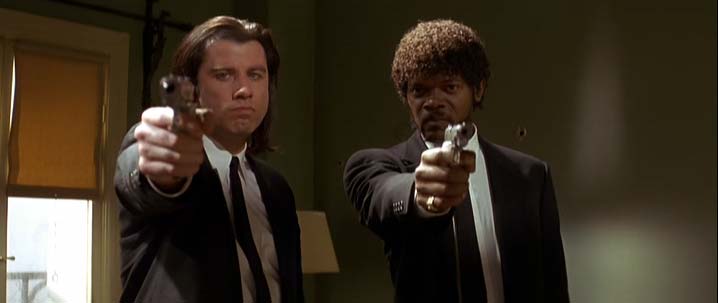
Although I didn't find it especially appealing, the third and last part left us this famous shot with Travolta and Jackson pointing their guns at the screen

sábado, 20 de octubre de 2012

'Schindler's List' (Steven Spielberg, 1993)


Title: 'Schindler's List'

Release Year: 1993

Director: Steven Spielberg

Cast: Liam Neeson, Ben Kingsley, Ralph Fiennes, Caroline Goodall, Jonathan Sagall, Embeth Davidtz.

Plot: Thanks to his social skills and his inteligence, Oskar Schindler rises as a businessman in World War II. When he's given the property of a factory in Krakow, he realizes that he has the perfect chance to save the life of innocent people.

Review: The quintessential Nazi drama, Spielberg left his blockbuster era with this film and directed a comprehensive story about the Holocaust. Raw, powerful and morally challenging, 'Schindler's List' is Steven Spielberg at his best.

A part from the talented director, we find a high quality cast with a set of unforgettable performances. First, we find Schindler, beautifully portrayed by Neeson. He's the main protagonist, usually opposed to the idea's of Amon Goeth. Obese and a real tyrant, the complex character that Fiennes delivers is one of the film main achievements, a real basilisk that imposes the horror among the jews he commands. He has secretly fallen in love with Helen Hirsch, up to the point of loving her even if he 'doesn't consider her a human'.


Fiennes' Amon Goeth is a marvelously complex character, a psychotic tyrant out of his mind, that gives both redemption and death in the rollercoaster that his feelings towards Helen creates in his mind

Another of the high points of the film is its visual and sound quality. From the black and white colorization, created to stand out the red of the little Jewish girl who Schindler wanted to save and ultimately is cremated, to the incredibly powerful score developed by John Williams. They both contribute to making of 'Schindler's List' a sober yet emotional tale in which even the most atrotious of the deaths is shown with not even an inch of morbidity. Scenes like the one in which the Jews are brought to the showers and suddenly they are relieved to see that water comes out of them make of this movie a modern time masterpiece that every moviegoer should see.

The little girl with the red coat is murdered at some point in the movie and Schindler contemplates her cremated body, a fact that strongly impacts him and leads him to question what is happening in society. It's the turning point of the film

Finally, we have the moral dilemma of deciding whether Schindler was good or just was taking advantage of the situation. I strongly believe that the answer is a mix between both situations. Let's face it; if he hadn't had the chance of earning money I doubt he would have started with his strange enterprise. But in spite of that, he was a brave man. Maybe not a hero but yes, a fair one, capable of seeing that what was being done with the Jews was an unfair massacre, a genocide of massive proportions. In the last scenes, he finally understands that having given the money he spent in his luxurious life, he could have saved many lives, and it is for that redemption that he is honoured at the end of the film, when the actors (not the characters, people with ordinary clothes!) leave each of them a stone on his grave. The perfect ending? Schlinder standing in front of his own death body.

Real life Schindler's grave. His persona is one of the most difficult to understand, with many moral debates over the nature of his action and the side he supported in the Nazi-against-the-Jews war

viernes, 19 de octubre de 2012

'The Silence of the Lambs' (Jonathan Demme, 1991)


Title: 'The Silence of the Lambs'

Release Year: 1991

Director: Jonathan Demme

Cast: Jodie Foster, Anthony Hopkins, Scott Glenn, Ted Levine.

Plot: Aspiring to be part of the FBI, Clarice Starling is offered the mission of catching 'Buffalo Bill' a serial killer who skins his victims. To achieve it, Starling will have the dangerous help of Hannibal Lecter, a brilliant psychoanalyst and also a lethal murder.

Review: 'The Silence of the Lambs' is terrific. From the performance of its cast to the quiet, dangerous aura that surrounds the film. It's intelligent, terrifying and a must-see movie for every moviegoer.

To start with, we have Foster's Clarice. In a world dominated by me (she has only one female friend in training) and mentally insane serial killers, she delivers a terrific performance capable of leading the film, being intelligent, cautious and emotionally round in every scene. With such a set it's difficult not to support her, much more when we know that danger surrounds her.


Jodie Foster's character has to deal with a world led by men and psychologically demanding encounters with Lecter. Their compenetration is a key factor for the movie

In the 'evil side' we find Hannibal Lecter. Hopkins' most remembered performance and one of the most acclaimed villains of all time, he delivers every sentence with the confidence of a higher mind who knows that he can control other people's minds. Leaving the fact that he eats people behind, he generales more acceptance by the audience than the majority of flat good characters that we see nowadays.

Anthony Hopkins in a terrific performance, one of the most remembered and acclaimed of film history

Their combination is used to identify the criminal and in a delicious final twist we discover that what we thought was a predictable ending (Hopkins and Starling have helped the FBI find 'Buffalo Bill') is indeed a mortiferous danger for Starling. After some minutes of pure tension, she arrests and kills the serial killer and is able to finally graduate.

"Well, Clarice; have the lambs stopped screaming?" In a terrific ending, delicious for any moviegoer, Lecter says goodbye to Clarice and the audience observes how he is planning one more crime. Whispering "Doctor Lecter... Doctor Lecter!" Clarice is left baffled, holding the phone (we suppose that the lambs have actually stopped screaming as they've caught the serial killer)
¡Recomienda este blog!