Latest Reviews

lunes, 22 de octubre de 2012

'The Shawshank Redemption' (Frank Darabont, 1994)


Title: 'The Shawshank Redemption'

Release Year: 1994

Director: Frank Darabont

Cast: Tim Robbins, Morgan Freeman.

Plot: Andrew Dufresne is sent to prison to fulfill a penal servitude for life after he's condemned for the murder of his wife and her lover. After years of imprisonment he gains the trust of the prison headmaster and the respect and admiration of his prison mates, especially Red, the 'one who gets what you want in prison'.

Review: If you're a moviegoer, you'll know that the condemned-man-breaks-free plot is quite common in American cinema, maybe because it's powerful and reaches one of the most beloved topics in film industry: freedom. Anyhow, 'The Shawshank Redemption' is not only a smartly planned leak from prison, it's a real personal journey for its leading characters.

Marvelously cast, Andrew and Red become friends after some time in prison. Freeman's Red, the narrator, quickly feels a secret admiration for him and his quiet behaviour. Many critics said that the fact that Dudresne seems all the time detached from everything didn't contribute to the audience's connection with the film, but I personaly found his performance impressive and raw. Moreover, his character is smart and clever, and responsible for the major plot twist in the film; his escape unfolds so incredibly that the audience is left baffled observing the poster of Raquel Welch. When after crawling for hundreds and hundred of meters of crap he finally reaches the water and liberates himself, any detached member of the audience must feel connected with the character, in a powerfully emotional scene, a symbol of his success over the tyranny imposed by the prison's headmaster, a corrupt character whose moment to pay arrives later in the movie thanks to the visionary mind of Dufresne.


As the marvelous score sounds, Dufrasne escapes from prison in this beautiful and wonderful scene

The other main topic in the film is the belonging to the prison, the fact of being 'institutionalized'. When Brooks is set free almost fifty years after he was condemned, he must return to an unknown and changed society (he entered at the beginning of the 20th century and goes out in 1954) where he feels he has no place or recognition (unlike in prison, where he was considered an educated man) and ultimately kills himself, but hanging from a beam, after writing 'Brooks was here'. The same situation happens when after years of questionnaires they let Red go. He starts to understand Brooks as he feels too old for a society where he no longer belongs and, the same way that he suffered for the possibility of Andrew killing himself for so many years of unfair imprisonment, the audience starts fearing the worst. But his time, Drufrasne is there to help him; he visits the location that he indicated him once to go if he ever was freed and there he finds (as Andrew had planned) money and a letter to join his friend in Zihuatanejo, a Mexican Pacific coastal town, which he ultimately does, writing 'So was Red' next to the message left by Brooks and violating his parole. At the end, both friends reunite as they hug each other in an emotional ending.


The friendships of Andrew, connected in prison through the years, is what leads the movie from its beginning to the very end

domingo, 21 de octubre de 2012

'Pulp Fiction' (Quentin Tarantino, 1994)


Title: 'Pulp Fiction'

Release Year: 1994

Director: Quentin Tarantino

Cast: John Travolta, Samuel L. Jackson, Bruce Willis, Uma Thurman.

Plot: Jules and Vincent are two hitmen under the orders of Marcellus Wallace. The story, narrated in a non-lineal way, tells how they accomplish two missions; recovering a valued briefcase and the dangerous task that Vincent has of taking care of Marcellus' wife, Mia.

Review: In many ways, Quentin Tarantino is a visionary. After creating 'Pulp Fiction' he doubtlessly proved it. With a top-notch cast and a smart and intertwined script, 'Pulp Fiction' has become a cult movie over the years.

The film has three parts. The first one is my favourite. The odd chemistry between Vincent and Mia (my favourite character) is delicious and their story is as intelligent and funny as it can be. Focusing especially on their characters, Vincent is a disaster. Later in the film he will kill a man just because he wasn't careful enough. It's not a strange thing that he leaves his heroin with Amy when he goes to the bathroom and doesn't realise that she has mistaken it with her cocaine and she's almost dead because he's convincing himself that he must leave the house before he tries to overstep the mark with the boss' wife. Hers is a brilliant composition. Different, with an electric style (am I the only one who laughed at her joke?) and some amazing dancing moves, I would've loved the movie with those two as the leads all the time; their chemistry is palpable at the end of their 'date'.


The famous dancing scene that Mia and Vincent share is one of the best moments of the film

The problem is that the movie continues without them and in every part, I lose interest a little bit more. This way, willis' part was still entertaining (very funny and weird). The status of the situation changes constantly between "you're a dead man" and "you're the boss". And although the sodomizing scene was kind of strong for me, the change of roles between lethal enemies and occasional companions that Willis character and Marcellus experience is a refreshing plot twist. At the end, not even I (a happy ending lover) can understand how the lucky man has escaped from such a situation alive. Even at the last moment, when his girlfriend spends too much time to jump on the motorbike, you're all nerves thinking something bad is going to happen again. Another great mark for that part two.


The attempts of Willis character to escape with his girlfriend are the main plot of the second part

Then we reach the flashback with a third part. I strongly believe that this one was not necessary. Yes, it connects the beginning of the film with its first part and it features the 'enigmatic briefcase' once more (the golden light coming from inside but no revealing its content adds more intrigue to the situation), but the scenes featuring Tarantino (a good actor, by the way) and the cleaning of the bloody car and Jules' revelation are not that appealing to me as the first parts. Moreover, as the film ends with the beginning, it leaves you with a strange feeling and with the spectator wanting to see more about Travolta and Thurman unquestionable chemistry (an unrealistic possibility; he's murdered by Willis character).


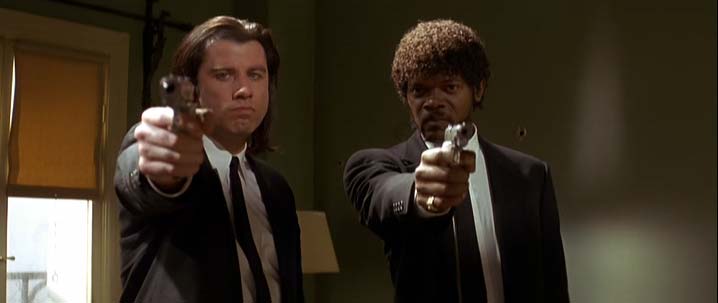
Although I didn't find it especially appealing, the third and last part left us this famous shot with Travolta and Jackson pointing their guns at the screen

sábado, 20 de octubre de 2012

'Schindler's List' (Steven Spielberg, 1993)


Title: 'Schindler's List'

Release Year: 1993

Director: Steven Spielberg

Cast: Liam Neeson, Ben Kingsley, Ralph Fiennes, Caroline Goodall, Jonathan Sagall, Embeth Davidtz.

Plot: Thanks to his social skills and his inteligence, Oskar Schindler rises as a businessman in World War II. When he's given the property of a factory in Krakow, he realizes that he has the perfect chance to save the life of innocent people.

Review: The quintessential Nazi drama, Spielberg left his blockbuster era with this film and directed a comprehensive story about the Holocaust. Raw, powerful and morally challenging, 'Schindler's List' is Steven Spielberg at his best.

A part from the talented director, we find a high quality cast with a set of unforgettable performances. First, we find Schindler, beautifully portrayed by Neeson. He's the main protagonist, usually opposed to the idea's of Amon Goeth. Obese and a real tyrant, the complex character that Fiennes delivers is one of the film main achievements, a real basilisk that imposes the horror among the jews he commands. He has secretly fallen in love with Helen Hirsch, up to the point of loving her even if he 'doesn't consider her a human'.


Fiennes' Amon Goeth is a marvelously complex character, a psychotic tyrant out of his mind, that gives both redemption and death in the rollercoaster that his feelings towards Helen creates in his mind

Another of the high points of the film is its visual and sound quality. From the black and white colorization, created to stand out the red of the little Jewish girl who Schindler wanted to save and ultimately is cremated, to the incredibly powerful score developed by John Williams. They both contribute to making of 'Schindler's List' a sober yet emotional tale in which even the most atrotious of the deaths is shown with not even an inch of morbidity. Scenes like the one in which the Jews are brought to the showers and suddenly they are relieved to see that water comes out of them make of this movie a modern time masterpiece that every moviegoer should see.

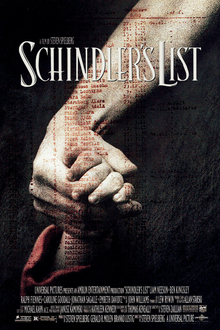
The little girl with the red coat is murdered at some point in the movie and Schindler contemplates her cremated body, a fact that strongly impacts him and leads him to question what is happening in society. It's the turning point of the film

Finally, we have the moral dilemma of deciding whether Schindler was good or just was taking advantage of the situation. I strongly believe that the answer is a mix between both situations. Let's face it; if he hadn't had the chance of earning money I doubt he would have started with his strange enterprise. But in spite of that, he was a brave man. Maybe not a hero but yes, a fair one, capable of seeing that what was being done with the Jews was an unfair massacre, a genocide of massive proportions. In the last scenes, he finally understands that having given the money he spent in his luxurious life, he could have saved many lives, and it is for that redemption that he is honoured at the end of the film, when the actors (not the characters, people with ordinary clothes!) leave each of them a stone on his grave. The perfect ending? Schlinder standing in front of his own death body.

Real life Schindler's grave. His persona is one of the most difficult to understand, with many moral debates over the nature of his action and the side he supported in the Nazi-against-the-Jews war

viernes, 19 de octubre de 2012

'The Silence of the Lambs' (Jonathan Demme, 1991)


Title: 'The Silence of the Lambs'

Release Year: 1991

Director: Jonathan Demme

Cast: Jodie Foster, Anthony Hopkins, Scott Glenn, Ted Levine.

Plot: Aspiring to be part of the FBI, Clarice Starling is offered the mission of catching 'Buffalo Bill' a serial killer who skins his victims. To achieve it, Starling will have the dangerous help of Hannibal Lecter, a brilliant psychoanalyst and also a lethal murder.

Review: 'The Silence of the Lambs' is terrific. From the performance of its cast to the quiet, dangerous aura that surrounds the film. It's intelligent, terrifying and a must-see movie for every moviegoer.

To start with, we have Foster's Clarice. In a world dominated by me (she has only one female friend in training) and mentally insane serial killers, she delivers a terrific performance capable of leading the film, being intelligent, cautious and emotionally round in every scene. With such a set it's difficult not to support her, much more when we know that danger surrounds her.


Jodie Foster's character has to deal with a world led by men and psychologically demanding encounters with Lecter. Their compenetration is a key factor for the movie

In the 'evil side' we find Hannibal Lecter. Hopkins' most remembered performance and one of the most acclaimed villains of all time, he delivers every sentence with the confidence of a higher mind who knows that he can control other people's minds. Leaving the fact that he eats people behind, he generales more acceptance by the audience than the majority of flat good characters that we see nowadays.

Anthony Hopkins in a terrific performance, one of the most remembered and acclaimed of film history

Their combination is used to identify the criminal and in a delicious final twist we discover that what we thought was a predictable ending (Hopkins and Starling have helped the FBI find 'Buffalo Bill') is indeed a mortiferous danger for Starling. After some minutes of pure tension, she arrests and kills the serial killer and is able to finally graduate.

"Well, Clarice; have the lambs stopped screaming?" In a terrific ending, delicious for any moviegoer, Lecter says goodbye to Clarice and the audience observes how he is planning one more crime. Whispering "Doctor Lecter... Doctor Lecter!" Clarice is left baffled, holding the phone (we suppose that the lambs have actually stopped screaming as they've caught the serial killer)

jueves, 18 de octubre de 2012

'Sophie's Choice' (Alan J. Pakula, 1982)


Title: 'Sophie's Choice'

Release Year: 1982

Director: Alan J. Pakula

Cast: Meryl Streep, Kevin Kline, Peter MacNicol.

Plot: The aspiring writer Stingo arrives at a family guesthouse to write his first novel but he's disturbed by the presence of a young couple conformed by Nathan Landau, a troubled unstable man and Sophie Zawistowski, a polish woman who can't scape her past.

Review: After she was overacted in 'The Hours' (one of my favourite movies) and somehow spoiled its quiet pace, I've had never trusted Streep's skills anymore. After 'The Iron Lady' I regained some of the trust but it's with 'Sophie's Choice' that I have seen what Meryl Sreep is capable of.

Mostly led by her, Pakula's film focuses on the three friends. One is the observer who falls in love with Sophie. The other is Sohpie's mentally ill boyfriend, who lies about his job and his faculties everyday. The final one is a complex, tortured woman who lives terrifyed for the decision that she had to make years before.

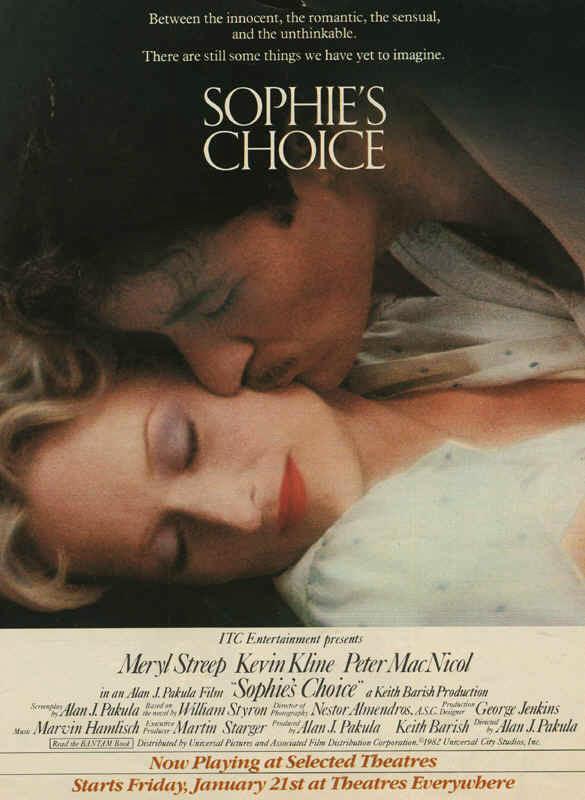
Meryl Streep gives a mesmerizing performance as Sophie Zawistowski

Streep's performance is out of this world; from the concentration camp when she's skinny and bald, to the days she suffers from high fevers and anemia and the present day. Imitating the accent of a real Polish to perfection, Streep transforms Sophie into a vehicle to show everything she has to give. And the level she achieves is so remarkable that it leads the movie by herself.


Tortured by her past, Streep's character can't forget the decision she had to make in order to save one of the children; condemning the other

Together with the complicated trio that she has with her psychotic boyfriend and the sweet yet nervous Stingo, she tries to live a normal life, but she can't forget the day that, in the camp, she had to decide (to choose) which of his children was going to live and which one was going to be cremated (the first day they arrive). The fact that then the other is also killed while staying in the camp may take away some importance to this decision for the spectator, but as a mother she had to be responsible for ending with the life of one of her kids. How she escapes is left unsaid (she had a deal to save his son that fails but nothing is said of a deal for her), maybe because her soul is still kept in there, never forgetting the final screams of her daughter.

Sophie's choice. Meryl Streep shot the scene only once and didn't want to do it again. Already a mother at that time, she later said that the scene had been exhausting and psychologically demanding to make

miércoles, 17 de octubre de 2012

'E.T. the Extra-Terrestrial' (Steven Spielberg, 1982)


Title: 'E.T. the Extra-Terrestrial'

Release Year: 1982

Director: Steven Spielberg

Cast: Dee Wallace, Peter Coyote, Henry Thomas, Drew Barrymore, Robert MacNaughton.

Plot: After being abandoned in Planet Earth, a little outer space creature, 10-year-old Elliott finds him and together with his brothers tries to find a way to find it a way to return before police and scientists can find them.

Review: Another Spielberg movie, this time it's an unquestionable success. There's nothing about the endearing extra-terrestrial story that I would like to change. Add to this that the film is a remarkable technological achievement and that it is based on the imaginary friend that Spielberg created after his parents' divorce and it's difficult not to praise him

The friendly E.T. quickly establishes a beautiful relationship with the children of the family, especially connecting with Elliott, who considers him a friend instead of just a weird creature and wants to protect him from the greedy hands of scientists or press. As many times, only children understand the real meaning of a friendship, far beyond the economic and scientific interests that the particular situation may involve.

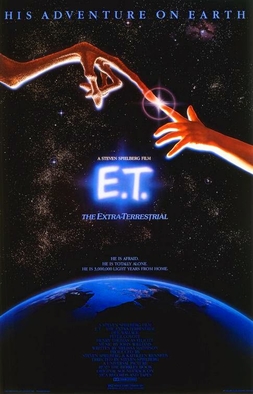
The iconic image of Elliott and E.T. flying with a bycicle

But drama reaches the story when the extra-terrestrial gets sick, and nearly dies. It's quite tough to see Elliott shouting at the doctors and claiming that they are killing E.T. So when it eventually recovers and they escape to the forest, you wish nothing but their mission will triumph.

In the end, E.T. says goodbye to his human friends, while in tears the children let their curious companion go. At this point I was already crying; the story is so beautifully made... It's evident that Spielberg made it carefully as it was also part of his childhood, a world that adults don't understand, as they don't understand the friendship between an outer-space creature and a 10-year-old human being (usually understood as a tale of tolerance and mutual understanding in which even the most different creatures can help each other).

"E.T. Phone Home" The remembered sentence met with the extra-terrestial's farewell for an emotional and moving ending

martes, 16 de octubre de 2012

'Raiders of the Lost Ark' (Steven Spielberg, 1981)


File:Raiders.jpgTitle: 'Raiders of the Lost Ark'

Release Year: 1981

Director: Steven Spielberg

Cast: Harrison Ford, Karen Allen, Paul Freeman, Ronal Lacey, John Rhys-Davies, Denholm Elliott.

Plot: Archeologist Indiana Jones is entrusted with a dangerous mission: finding the Lost Ark that contains the fragments of the Ten Commandments before the Nazis do it, as it's thought that they grant an enormous power those who possesses them.

Review: As it was the first installment of a very successful franschise and had Spielberg directing it, I was waiting for an entertaining action movie with a complex, well-structured story. No, no and no.

'Raiders of the Lost Ark' (which I chose over 'Blade Runner' in what it was a clear bad decision) is a weak blockbuster that lacks the strength of other franchises. It's usually not as funny as it should and contains many plot forgetable topics. First of all, it is a film really based on the idea that Nazis would risk their lives to find the Ten Commandments believing that they would achieve an incredible power? Really? It has little credibility. Moreover, although Ford's Indiana is well acted and has enough human weaknesses (like his fear of snakes) to connect with the audience, his love story with Marion is quite predictable, not offering much new challenges (which doesn't exactly mean that I dislike it).


A Harrison Ford at the top of his career was chosen to star as Indianda Jones in Spielberg's film. It was critically and economically successful, although for me it has been a major disappointment

This way, the first Indiana Jones' film unfolds as a quite dull and unrealistic adventure with a limited success as it sometimes even fails to entertain younger audiences.

lunes, 15 de octubre de 2012

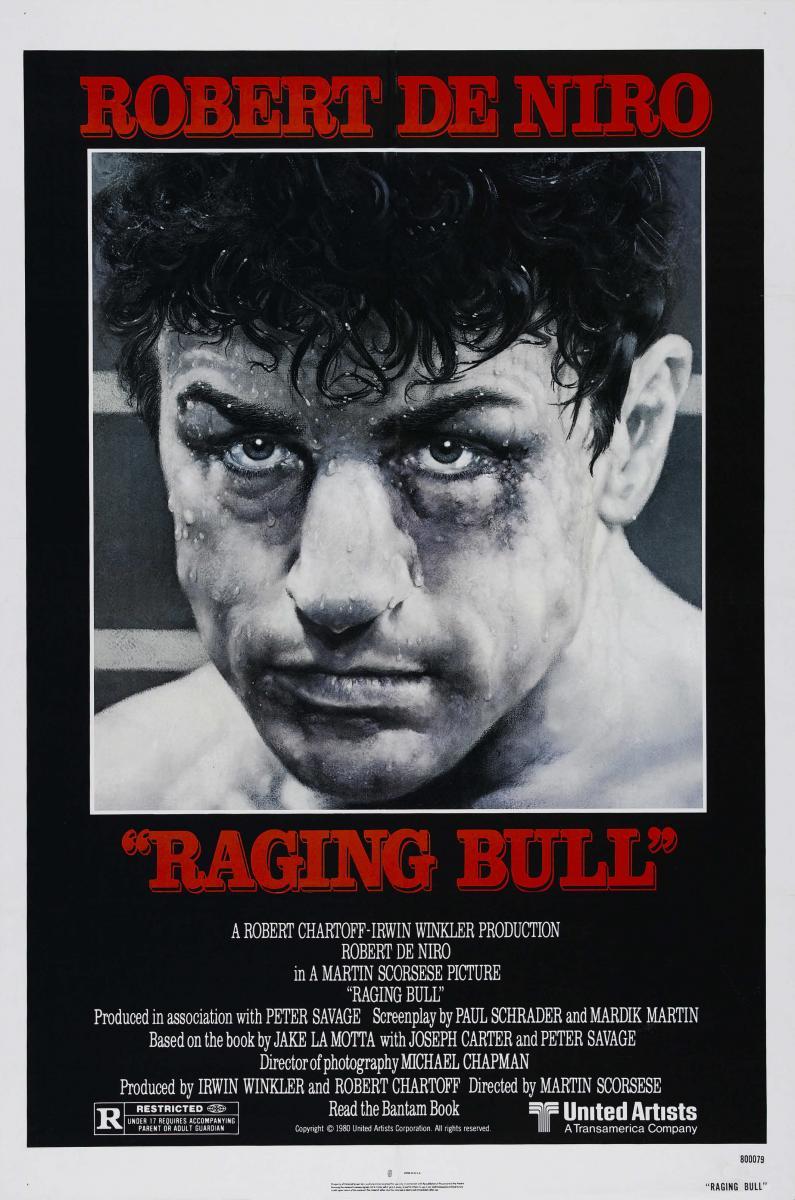
'Raging Bull' (Martin Scorsese, 1980)


Title: 'Raging Bull'

Release Year: 1980

Director: Martin Scorsese

Cast: Robert De Niro, Cathy Moriarty, Joe Pesci.

Plot: The film tells the rise and fall of Jake la Motta, a successful boxer whose insecurities endanger both his personal and professional life.

Review: Martin Scorsese is one of my favourite directors and usually I adore his movies. 'Raging Bull' has been the underwhelming exception to the general rule.

That doesn't mean it was a bad movie. Generally it is listed as one of the best films of all time and Robert De Niro's performance is nothing but spectacular.

The problems is that the typical atmosphere of violence in which Scorsese usually floods his characters (that almost always delivers wonderful  and raw results) seems strangely out of place. I can understand that la Motta was a very complex person; he was strong and powerful in the ring, but once he was outside, his insecurities made him a weak man. But somehow, you always expect some kind of redemption, an evolution that justifies the whole run that the character has made. On the contrary, as time goes by, De Niro's character only becomes worse, maybe influenced by the also questionable conduct of his brother.


Jake la Motta: a story of violence and insecurities sunk by its own weight

All this contributes to a certain detachment of the audience with the film and ultimately leads to an incomplete cinematographic experience. In the end, when an overweight la Motta recites one of Marlon Brando's most memorable speeches in 'On the Waterfront', you feel that they've left something behind, that something is missing; la Motta starts as a fragile-minded persona and this characteristic drives his entire life until his disppointing ending, with no evolution in the meantime. When he finally decides to take the stage one more time, you ask yourself if the journey had any sense to begin with, other than showing the extreme transformation De Niro had to go through to embody his troubled character.

domingo, 14 de octubre de 2012

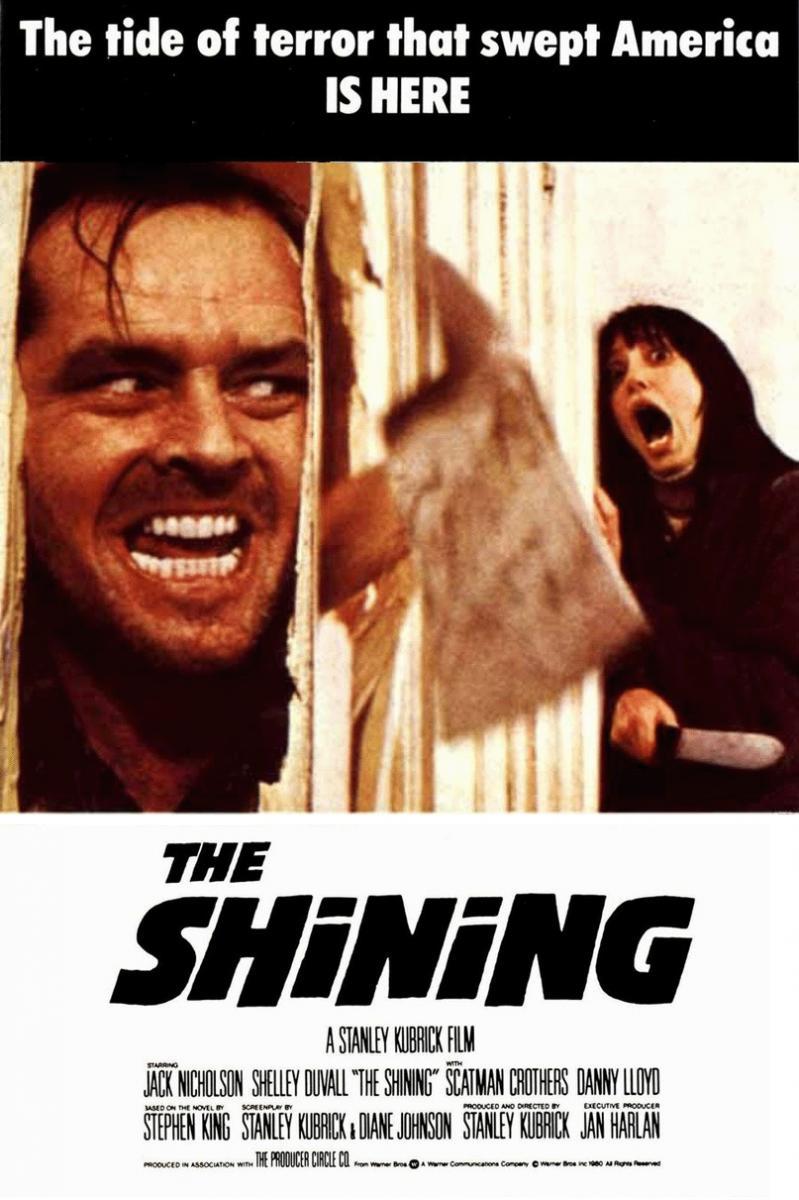
'The Shining' (Stanley Kubrick, 1980)


Title: 'The Shining' 

Release Year: 1980

Director: Stanley Kubrick

Cast: Jack Nicholson, Shelley Duvall, Danny Lloyd, Scatman Crothers.

Plot: Jack Torrance moves in the Overlook hotel with his family to take care of it while it remains closed in the winter season. But although his initial intention is finding peace to write his novel, as different paranormal events occur, he starts to lose his mind and eventually tries to kill his wife and son.

Review: 'The Shining' didn't have easy beginnings. When it was released in 1980, it wasn't met with critical acclaim and Stanley Kubrick received a Razzie nomination for Worst Director. Through the years it gained a cult following as the film was reassessed as a horror classic.

I truly can understand why it didn't meet expectations when it was released; it was long, complex and some of the supernatural events did not have an explanation and people didn't understand the film well. I did also struggle with the difficult plot twists and time impossibilities and ended asking myself: does the story even have sense? And it's at that moment when I think that the film suceeds; while making the audience suffer to understand the hows and the why the film catches it, in the same way that the Overlook hotel trapped a Jack Torrance that 'had always lived there'.

  
Hello, Danny. Come play with us. Come play with us, Danny; Forever, and ever... and ever. The unforgettable scene featuring 'The Shining twins'

Anyway, even if they had problems with the plot, I don't understand why they couldn't praise Jack Nicholson's performance. It's the best work that I've seen of him and obviously deserved more than a Saturn Award nomination. His wonderfully acted and marvelously portrayed Jack Torrance leads a film that creates a universe where you can lose yourself, in the same way as Jack lost himself in the haunted hotel maze... and never escaped. Was he there from the very beginning? Why was there a photo of him at the principal hallway dated 1921? Are he and Grady the same person? Is the dead woman in the bathroom Grady's dead wife? And the twins... are they his daughters? Why does the elevator open to reveal a blood cascade? Why is Danny able to perceive the hotel's 'Shining' and why does he start whispering 'REDRUM' (Murder written backwards)? Those are enigmas yet to be solved.

'Here's... Johnny!', the line that is now a part of film history

sábado, 13 de octubre de 2012

'Apocalypse Now' (Francis Ford Coppola, 1979)


Title: 'Apocalypse Now' 

Release Year: 1979

Director: Francis Ford Coppola

Cast: Marlon Brando, Robert Duvall, Martin Sheen, Frederic Forrest, Albert Hall, Sam Bottoms, Lawrence Fishburne, Dennis Hopper.

Plot: Captain Willard has been given the mission of entering Vietnam wild jungles to find General Kurtz, who after an exemplary career has become insane and lives as the head of a tribe that worships him.

Review: After watching its huge length and the time it took to be shot I truly expected a soporific war-themed movie in which Francis Ford Coppola had wasted too much money. Nothing could further from reality: 'Apocalypse Now' is a great masterpiece and the biggest surprise as an unexpected revelation of this research project.

A rave story about the disastrous consequences of war, this is cinema at its most visionary and audacious level, a hallucinatory tale of self-destruction and a result of the psychological scarfs that the Vietnam war left in soldiers.


The technical perfection of the film accentuates the sensation of delirium and madness

This way we advance through a visually dazzling story and a country where fire and water are fused and each of them seems more lethal than the previous one. In a world region were madness has seized power and there's little sanity left, Sheen's character tries to find the lost General, while trying to understand the reason why he lost his way.

That last task is very difficult to accomplish, since when he locates him (in the heart of the jungle in an indigenous camp), all that is left is an insane despotic creature, who lives adored as a god and surrounded by a delirious infinity of massacred bodies and severed heads distributed all over the village. Kurtz has definitely lost his mind after so many years of irrational hate and murders and as he awaits for Willard to kill him he concludes this massive work of art with his final meaningful words: 'The Horror... The horror...'


A mentally insane Marlon Brando appears only in the last part of the film, but transformates it into a must-seen masterpiece about the rave consequences that war has in men
¡Recomienda este blog!