Latest Reviews

Mostrando entradas con la etiqueta 1960s. Mostrar todas las entradas

lunes, 1 de octubre de 2012

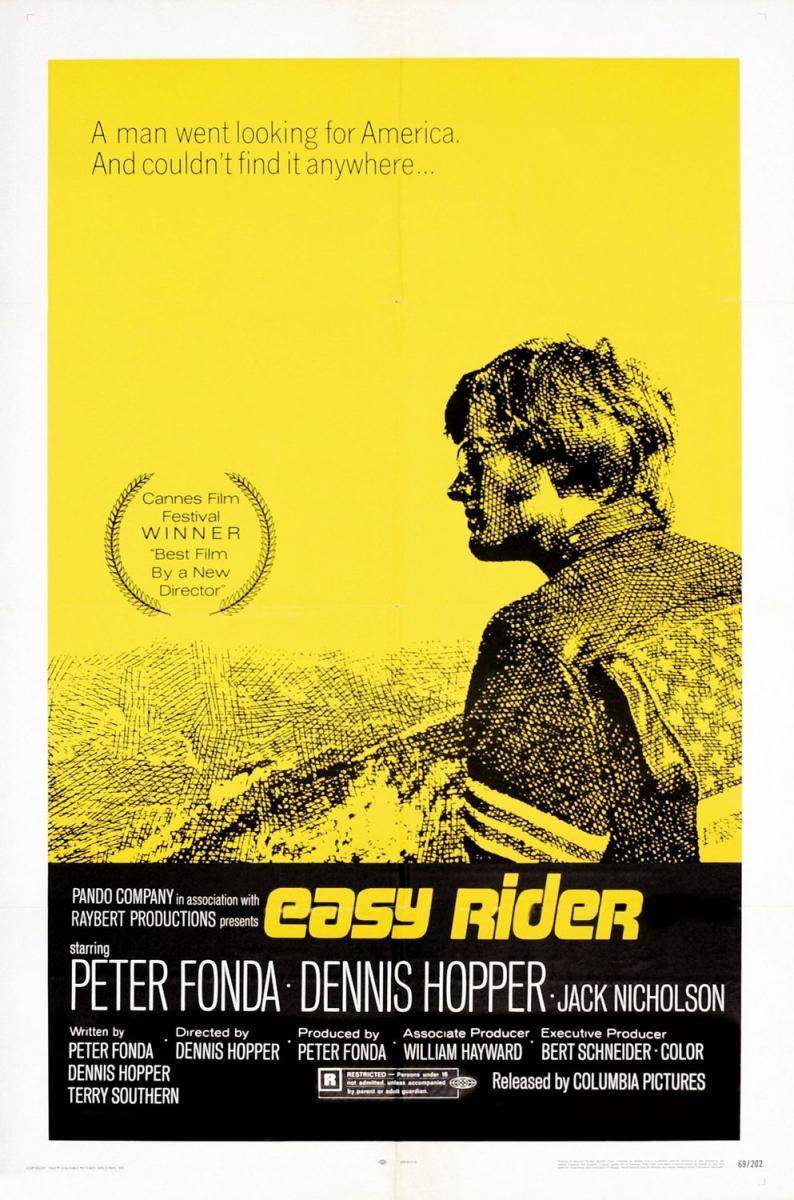
'Easy Rider' (Dennis Hooper, 1969)


Title: 'Easy Rider'

Release Year: 1969

Director: Dennis Hooper

Cast: Peter Fonda, Dennis Hooper, Jack Nicholson.

Plot: Two freewheeling hippies cross the country going to New Orleans, as they discover themselves.

Review: 'Easy Rider' has really baffled me. To make it short, they spent the whole movie taking drugs, they met Nicholson's character and then they all died.

Without meaning that everybody in that age was drug addicts, I think that the film had much more sense in the late 1960s for the need of freedom of the youth, searching the track of their futures. As for the drugs, hippie community was known for using them to reach ecstasy and alterated states of consciousness (as seen in the scene with the hookers in the cemetery). Far beyond its important social connotations, the film itself offes little for a different time moviegoer that hasn't studied film history before.
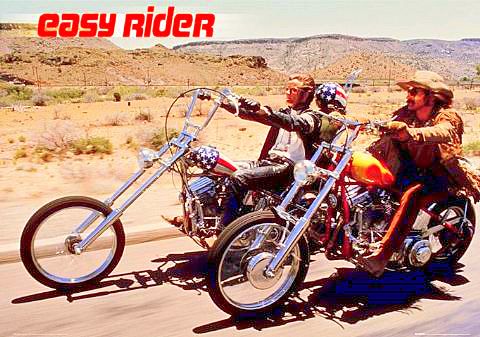
Freewheelers looking for their destiny...

As positive qualities we find Jack Nicholson's performance as a funny and drunk lawyer who brings some light between the smoke of the weed that impregnates the movie and the death of all of them (which somehow awakes a feeling of injustice for the killing of innocent people just for their lifestyles), especially the leading characters at the end of the film.

Jack Nicholson... one of a kind. Demonstrating his genius in his early films

domingo, 30 de septiembre de 2012

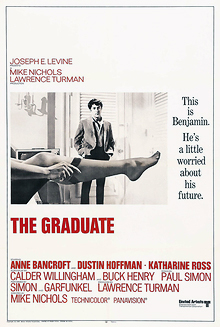
'The Graduate' (Mike Nichols, 1967)


Title: 'The Graduate'

Release Year: 1967

Director: Mike Nichols

Cast: Dustin Hoffman, Anne Bancroft, Katharine Ross.

Plot: Benjamin Braddock has just arrived home after finishing college. Worried about his future and desorientated in his life, he engages in a sexual relationship with a married woman and becomes  his lover.

Review: "Mrs. Robinson, you're trying to seduce me. Aren't you?" There are several reasons why I loved 'The Graduate'.

First because it continued the journey initiated by 'Bonnie and Clyde', talking about sex with a more open mind. Secondly, because Dustin Hoffman is an incredible actor with a unique technique, and portraits here a character that's difficult not to love. Finally because it features a sort of hippie story that identified not only with that time new movements but also with the feelings that every late-teenager has when thinking about an unsure future. For all those reasons, 'The Graduate' is an intelligent, funny (Benjamin seems constantly absent, a weird and insecure oberver of a world to which he doesn't belong) and innovative film appealing for new and old audiences.


"Mrs. Robinson, you're trying to seduce me. Aren't you?" Hoffman's Benjamin is one of a kind. A portrait of one of everbody's life phases in which we don't know what we are gonna do with our lives and ultimately a strangely funny creature

The relationship of Benjamin and Mrs. Robinson is a very complicated one. Their first 'compromised' meeting ends with a series of shoots intertwining his horrified face with her bare breasts. From then on, she's presented as a liberated woman that helps him lose his virginity, but deep down she represents a society anchored in the past; she ruined her life when she got pregnant and although she forgets it momentarily in her sexual encounters with Benjamin, she's, deep down, terribly unhappy because she can't escape from her reality. The culmination of that idea lays on her insistence of not letting Benjamin see her daughter Elaine, because she's absoutely afraid due to the possibility of him leaving her for a younger woman and being left alone in the dark again. Although he agrees at the beginning (treating Elaine despicably when he invites her to a humiliating session on a striptease club), but finally comes to terms with his own thoughts and feelings and decides to marry her, the woman he loves, instead of the old declining harpy (which was indeed, once again, a metaphore of what society had become and what it meant for youth).


Mrs. Robinson's offer is a poisonous one, a mindless sex proposition with major dangers behind her fake carefree and hypocritical façade

In the final scene, Benjamin interrupts Elaine's wedding with another man and escapes with her in a bus, after Elaine has her last revealing words with her mother: -"Elaine! It's too late" +"Not for me!" The ultimate breaking between former and new society, 'The Graduate' is definitely one of the most significant movies of its time.


Heading to nowhere. Elaine are Benjamin are an odd couple that I really loved. Thanks to his performance and their strong performance and the mix between his endearing insecurity and her breathtaking beauty

viernes, 28 de septiembre de 2012

'Who's Afraid of Virginia Woolf?' (Mike Nichols, 1966)


Title: 'Who's Afraid of Virginia Woolf?'

Release Year: 1966

Director: Edward Albee

Cast: Elizabeth Taylor, Richard Burton, George Segal, Sandy Dennis.

Plot: A young married couple is invited by the wasted older couple conformed by professors George and Martha. What starts as a peaceful evening ends as a self-destructive and dangerous game night that they will never forget.

Review: In the same way that I owed a film to Katherine and Audrey Hepburn, I also had a debt with Mrs. Taylor, who gives here the performance of a lifetime.

Apparently, the film is just a reflection of two many years for a wasted marriage that explodes in an arranged dinner. But as the film goes by, you discover that George and Martha's minds are too complex to be arguing about lesser mind topics. The following thought you have involves the possibility that they can no longer bear each other, and they are having the fight that will finally break them up. What you surely don't expect is the revelation that they're just playing a game called; 'imagine you have had a child, create it to fill the empty life of our married couple so we can pretend we have it and we can be happy, but never talk about him with other people, or the hoax will be destroyed'.

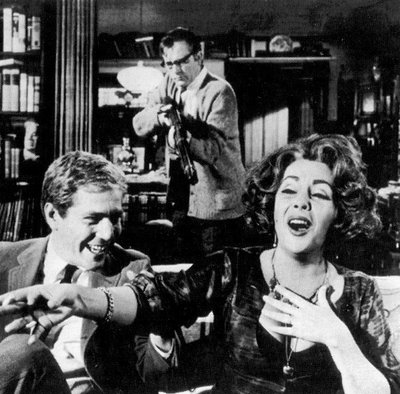
George and Martha have a tumultuos relationship. In this particular scene I really believed that he was going to murder her

As they play this dangerous game, they drag the young couple to their personal hell as they insult themselves, uncover other people secrets and even cuckold their respective couples (I think that in this last case, Martha went far beyond what was allowed in the game, but maybe it was all part of the game). Once they've ended only destruction is left and at the end George reveals that their son has died, causing that Martha accuses him commiting murder. Is that the truth? Yes and no. Yes, he's made the son disappear. No, he hasn't killed anybody because the son doesn't exist.

It's not difficult to think that George has killed his own son, as he's shown as an agressive character through the entire movie

At the beginning I didn't know what game they were playing and was horrified that George could kill his son, but his supposed evil persona is indeed ending a lie that has gone too far, as Martha has talked about his son to strangers, breaking the spell. She is a complex creature (my favourite cast member, together with Sandy Dennis, both of them winning Academy Awards in their respective fields for their performances), apparently more powerful than her husband for her father's status, but beyond the insults and intellectual torture towards her husband, an afraid and volatile creature.


Strong and powerful. That's how Taylor's character is presented

What does the title mean then? Well, first you must know that Virginia Woolf was a 20th century writer known for her realistic works. When asked by her husband 'who's afraid of Virginia Woolf?', she's literally being asked who's afraid of living a real life, without fake delusions of a happier reality where she's a mother, to which she finally answers 'I do'.

Strong in the outside, but deep down she is a tortured creature, prisoner of a life that she can't have

jueves, 27 de septiembre de 2012

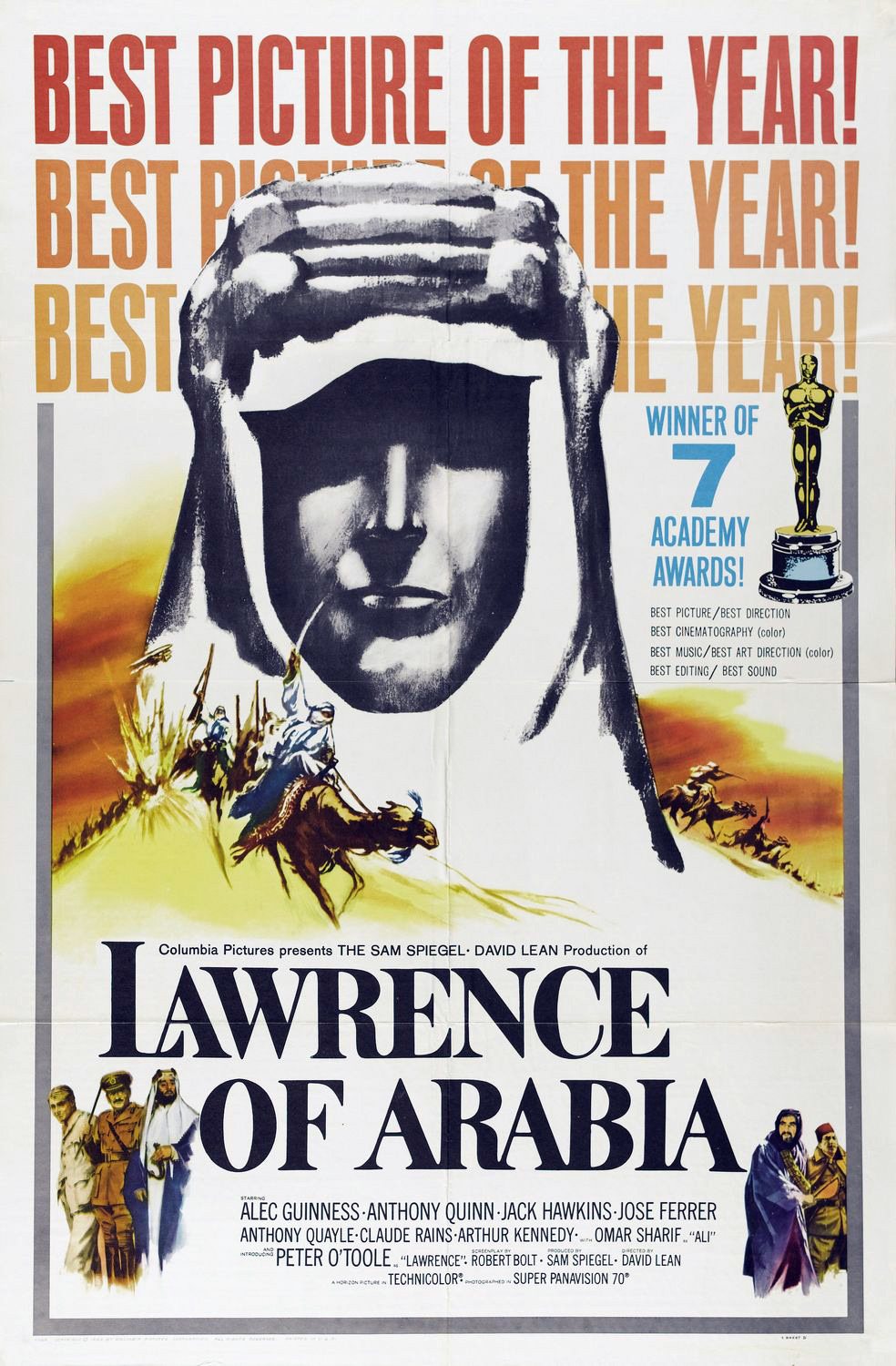
Lawrence of Arabia (David Lean, 1962)

/Note of the author: 'Lawrence of Arabia' is usually considered a British film, but as it received American funds and was distributed by their studios, it would be more correct to name it a coproduction between the two countries (and, by extension, also American). I could have chosen a 'more American' movie like 'The Sound of Music' (a Hollywood classic, a huge box-office success and a clear example of what remained of the golden days in the 60s), but I thought I would find this one more cinematically challenging./


Title: 'Lawrence of Arabia'

Release Year: 1962

Director: David Lean

Cast: Peter O'Toole, Alec Guinness, Antony Quinn, Jack Hawkins, Omar Sharif.

Plot: The movie explains the adventure of Lawrence of Arabia in Cairo during the World War I, when he was sent as the head of a support campaign for the arabs against Turkey.

Review: Lawrence of Arabia is definitely a complex character to describe. Sometimes you think his only motivation is helping the Arabic people, others he loses inexplicably the track and seems to have lost every hope and other just seems to enjoy popularity too much.

If you ask any moviegoer who's seen the film, they will tell you that they loved it, but I have my reservation. Yes, it's visually impressive, has a complex structure as well as a complex protagonist and a strong moral context, but that can't hide that so much complexity detaches the leading character (the only one that audiences have to feel connected to the film as he owns most of the screening time) from the audience and its atroucious length.

Peter O'Toole started a curse with this film: including the one received for 'Lawrence of Arabia' he's received 8 Academy Award nominations... and hasn't won any of them

Anyway, it has its unquestionable achievements. First an impressive performance from Omar Sharif (my clear favorite over O'Toole character, who never loses his way and stays faithful to his beliefs all the time). Second, some particular moments in which we really see the epic with wide moral consequences over the freedom of a country that the premise promises, although it's usually surrounded by a blurry environment in which is difficult to see what's positive and what's negative and who's the side you must support. In the end, even success and failure are fused in the final expression of the complex persona that Lawrence of Arabia is.

Always loyal to his own beliefs, Omar Sharif's character is my favourite in this movie, and would give the actor enough popularity to be chosen to star 'Doctor Zhivago' (David Lean, 1965)

miércoles, 26 de septiembre de 2012

'Breakfast at Tiffany's' (Blake Edwards, 1961)


Title: 'Breakfast at Tiffany's'

Release Year: 1961

Director: Blake Edwards

Cast: Audrey Hepburn, George Peppard, Patricia Neal, Buddy Ebsen, Mickey Rooney.

Plot: Holly Golightly is an extravagant woman with a curious life that lives an apparently easy life with her cat. But that life changes when she meets the aspiring Paul Varjak.

Review: In many ways, Audrey Hepburn was herself an anachronism of her age. A symbol of a golden era that no longer existed, she remained as an iconic actress in a changing era. Strangely, I loved her.

Usually I would have hated Holly's kind of character; shallow, leaving an unrealistic life... but Hepburn has demonstrated many times that she's the exception to the rule. Her character is a more-complex-than-it-seems composition; a mix between the lovingly unworried persona she embraces in her everyday life (like when she transmits 'the weather forecast' from a mafia boss in prison to his lawyer) and the real troubled woman that lays behind her skin, wanting so desperately to scape her past that she doesn't allow herself to be really in love, looking for a man between all the 'rats' she goes out with that will bring her the life status she deserves, where she can happily spent her days in her beloved Tiffany's. Yes, I loved her complex yet sweet persona.


Not only did I love the sweet voice of Hepburn singing 'Moon River' in this dreamy scene, but it has been also what I've been listening to during these lasts months while I was doing the project and I got stressed for the enormous quantity of information. Somehow it relaxed me.

And Paul Varjak is the kick in the ass she needs to change. Living a similar situation than her (although it's not specified, it's foreshadowed that he 'satisfies' Emily in exchange of economic support), he decides to the change his way of living and tries to convince Holly to do the same when she decides to go to South-America to find a rich man to marry with. She initially declines his love offer, but suddenly, after Paul gives her a marriage ring and leaves the taxi they were travelling in, she goes outside under the rain and, after finding her beloved cat (which she had previously left in the street), she kisses him as 'Moon River' sounds for the last time. She has finally understod that her love for him is stronger than her need for money and that she deserves to happy and loved. 'Casablanca' may have its fans, but for me 'Breakfast at Tiffany's' is the ultimate love story (even if some criticized it for thinking that the stereotypical personification of an asian man by an american actor was racist). 


The ending of the movie is beyond perfection. Holly finally escapes her cage in my favourite love scene of all time

martes, 25 de septiembre de 2012

'Psycho' (Alfred Hitchcock, 1960)


Title: 'Psycho'

Release Year: 1960

Director: Alfred Hitchcock

Cast: Anthony Perkins, Vera Miles, John Gavin, Janet Leigh.

Plot: After stealing an enormous quantity of money and disappearing, Marion Crane is killed at a motel by a mysterious murderer, who happens to have an unexpected identity.

Review: 'Psycho' was my second Hitchcock film and an opportunity to be amazed by the talented director after the underwhelming 'Vertigo'. As the movie goes by, you start thinking that such thing is not going to happen... until you reach the ending scenes.

One of the reasons is that the film is quite slow and has a big contrast with the assassination scenes. But once you see them, you can't stop shaking. The famous shower scene is only one of the multiple visually dazzling and perfectly executed murders that are shown in the film. Not only does it have the most horrifying score in film history, but it also uses an additional key factor; the killer arrives fast, kills fast and leaves fast.


The horror... Simply terrifying

With that technique, together with the quieter environment they're located in, the chills are assured, as you are left tense the rest of the movie, just to realize that at the exact murder moment you were again caught off guard.

And this way, we reach the ending. God, the ending is PERFECT. I had all the time the feeling that the mother was dead but when the son moves her in his arms to another room I thought: "Well, she's real! He's carrying her in his arms. He can't be speaking alone all the time...". But of course, I forgot the last option: a mummified mother is the cadaver with whom the insane Norman speaks to. The scene towards the end in which Marion's sister discovers the truth and he appears all of the sudden to murder her is a horror milestone that has never been achieved again. Hats off; Hitchcock is a genius.

The terrible truth is unfold in an incredible ending

At the end, the psychiatrist (in what it's an outstanding psychoanalysis excercise) unfolds the truth completely: Norman had murdered her many years ago and, tortured by guilt, he had kept her mummified persona to pretend she was still alive. And she was... in his mind. Battling with his real identity, the protective mother aroused inside him when she thought he was in danger (that's the reason why he kills Marion, because the mother identity doesn't want his son to be attracted by a woman), forcing him to dress up like her to commit the crimes as another person.

Finally, we see Norman talking alone with his mother's voice in his head (dominated by her identity), explaining his intention of seeming harmless by not smashing a fly that has just landed on his hand. And with a terrifying smile, the movie ends.


Completely insane and dominated by his mother; if we pay attention, as Norman smiles for the last time, his mother's skull can be seen intertwined with his face
¡Recomienda este blog!