Latest Reviews

Mostrando entradas con la etiqueta pre-1927. Mostrar todas las entradas

martes, 4 de septiembre de 2012

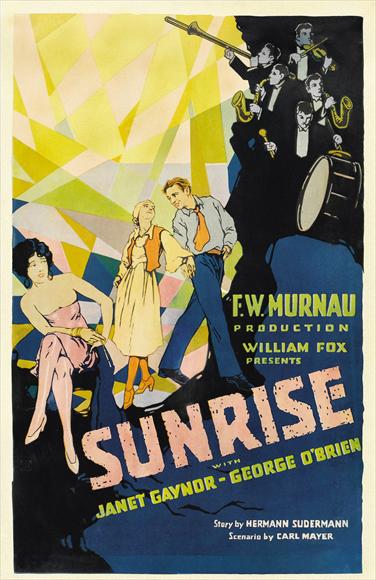
'Sunrise: A Song of Two Humans' (F.W. Murnau, 1927)


Title: 'Sunrise: A Song of Two Human'

Release Year: 1927

Director: F. W. Murnau

Cast: Janet Gaynor, George O'Brien, Margaret Livingston.

Plot: After almost killing her wife (Gaynor) incited by his lover (Livingston), The Man (a nameless character played by O'Brien) tries to get her back in a trip that would change their lives.

Review: The first best picture Academy Award winner and also the only fully silent one to win the prize (an honor shared with 'Wings'). It's not something that everyone can say. And not for no reason. 'Sunrise' outstands in many aspects that made of it a noteworthy movie.

First, it was a pioneer in terms of technical achievement; the superimposed sound or the way it had to go from one scene to another are some examples of that.

Moreover, it's filled with plenty of symbolism; the fact that the characters are nameless, the sun that rises as the love triumphs in a wonderful ending...

As the sun rises, 'The Man' and 'The Wife' kiss in a beautiful and powerful ending, thanks to a marvelous score (starting at minute 8:33 in the video)

As if that was not enough, the movie title can be seen as a metaphor of what the film is; 'a song of two humans' referring to how husband and wife try to reconnect after their marriage deals with his betrayal. I haven't decided yet if he should be forgiven or not, but taking in account how he struggles with guilt as he tries to make it up for his mistakes and how he ends up desolate when he thinks she's dead, it's reasonable giving him a second chance. Without taking in account the personal opinions about the ending, 'Sunrise' has many reasons to be remembered, including its first Best Actress Academy Award winner Janet Gaynor, who gives here a great leading performance in one of the first interesting roles I've seen from an actress to this point of the project.


Janet Gaynor gives a remarkable performance as 'The Wife' in 'Sunrise'

lunes, 3 de septiembre de 2012

'The General' (Buster Keaton, 1926)


Title: 'The General'

Release Year: 1926

Director: Buster Keaton, Clyde Bruckman.

Cast: Buster Keaton, Marion Mack.

Plot: After the war arrives in the USA and the army considers that Johnny Gray (Keaton) should stay in the rearguard instead of enrolling, he will do anything to prove to his love (Anabelle, Marion Mack) that he's not a coward and that he deserves her love.

Review: Keaton was, together with Charlie Chaplin, one of the greatest comedians of his age. And he proves it with this movie. His specialty? The laughs.

Yes, even though he may not reach the emotional level of his profession mate, everyone must agree that 'The General' is nothing but purely funny. Starting with the quite dumb protagonist and following with the great control that Keaton had over body expression, which demonstrate again how good slapstick comedy could be.


Buster Keaton, another comedy genius of cinema's early age

Another positive aspect is the music and 'score'. Even though the second one repeats over and over again, a silent film without background music is an anticipated suicide. Moreover, some of the sound effects are so ridiculous that they add another touch of humor to the movie (the "piuuuuuum" made by the bullet, my favourite).

The only important detail I didn't like was the now so old "man-needs-to-prove-his-courage-to-get-the-girl" story. But anyway, I suppose that was quite fashionable 80 years ago. What it's incontestable is that she (as the majority of female characters those days) is way more superficial than him and represents the complainer and vain woman prototype, Always looking for the man to save her and demanding him things... Surely it was the only role model then but still drives me crazy how useless she could be sometimes.

However, thanks to the profit that Keaton made of such a simple story (him, a locomotive and a kidnapping), the hilarious time you have with it, the union of music and special effects and the innocent, funny ending, 'The General' is an outstanding action comedy of cinema's early days that I really enjoyed.

Buster Keaton in 'The General' memorable scene

viernes, 31 de agosto de 2012

'The Gold Rush' (Charlie Chaplin, 1925)


Title: 'The Gold Rush'

Release Year: 1925

Director: Charlie Chaplin

Cast: Charlie Chaplin, Georgia Hale.

Plot: After going to Alaska seeking for gold at the beginning of the century, The Tramp will find himself in an old cottage of a bandid and falling in love with a saloon girl.

Review: second Chaplin movie I review (and surely not the last), and yet I never get tired of seeing him. It's true that I liked 'The Kid' much more, but any film of his is so endearing that you can't help but want to see another one.

Anyway, this time I found the story led entirely by Chaplin. First he fronts an incredibly funny first part trapped in the cottage with the two other gold-seekers. All by himself he gives warmth to the coldest winter with his lovely yet ingenuous character. Even when we get to the unbalanced love story (he's clearly more into her than she is) it's hard not to see how foolish the protagonist is. I simply love how naive he can be, and who doesn't feel sorry when Georgia plays with his heart? 'The Tramp' owns most of the movie's greatest scenes; him, lonely, standing in front of a happy dancing crowd, the famous 'roll dance'... Funny and sweet, Charlie Chaplin is just a genius of his field.


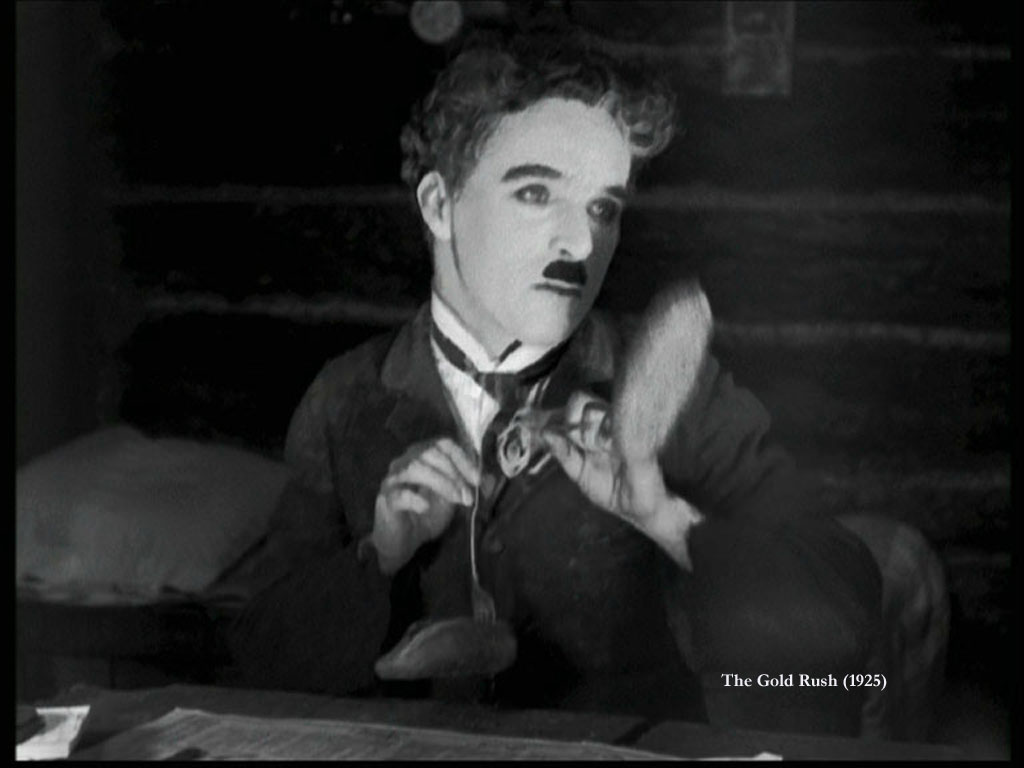
The aforementioned famous 'roll dance' performed by Chaplin in the movie

That's the reason why I can't entirely be happy when she finally wants to be with him. Yes, at the beginning she doesn't know that he's rich and still wants to help him when the guards try to throw him out of the boat, but later when they kiss she already knows it. It takes a wonderful score and one of the best endings of the Silent Era (seriously, what an ending!) to convince you that her feelings are true and noble.

The heartbreakingly beautiful ending of the movie

jueves, 30 de agosto de 2012

'The Kid' (Charlie Chaplin, 1921)


Title: 'The Kid'

Release Year: 1921

Director: Charlie Chaplin

Cast: Chalie Chaplin, Jackie Coogan, Edna Purviance.

Plot: After a poor London woman abandons her newborn child due to economic difficulties, The Tramp (Charlie Chaplin), adopts him and becomes his new father. Some years later, the woman, now a famous actress full of regrets, starts looking for him.

Review: I had never seen a movie of Chaplin before this one and I had some pretty high expectations. Surprisingly, they were largely fulfilled.

When I first heard about 'Slapstick', the comedy genre in which Chaplin was specialized, I was afraid I would have to face a whole hour of easy jokes and dumb gestures, but when I started watching the movie any previous idea went away.

File:Chaplin The Kid.jpgNot only was the film genuinely funny, but endearing and sweet. With plenty of symbolism, Chaplin created a story full of heart and his performance characterized as the iconic 'Tramp' only made it more special. Every scene where he's with the little kid, has so much magic that it's difficult not to fall in love with his cheerful and somehow naive character, especially the tearful scene they both share when they reunite after the police tries to take the chlld away from him. Exuding the essence of which good classic cinema is made of, 'The Kid' will remain as an ageless film that crowned Chaplin as a real genius of his field.


The iconic image of 'The Tramp' (Chaplin) and The 'Kid' (Coogan) sitting at the entry of their home.

martes, 28 de agosto de 2012

'Intolerance' (D. W. Griffith, 1916)


Title: 'Intolerance'

Release Year: 1916

Director: D. W. Griffith

Cast: Lillian Gish, Vera Lewis, Mae Marsh, Fred Turner, Robert Harron.

Plot: 'Intolerance' tells four different stories in four different periods of time, tied together by one connection; intolerance. They're; the fall of Babylon (539 B.C.), the crucifixion of Jesus in Judea (27 A.D.), the St. Barholomew's Day Massacre in France (1572) and a modern story set in 1914 which shows intolerance in moral puritanism and the disputes between capitalists and strikers.

Review: 'Intolerance' was made as a response to the criticism received by previous movie of the same director 'The Birth of a Nation', where Griffith was largely accused of racism.

Apart from its main topic, the movie also highlighted for its technical and story telling achievements, including all the advances from Griffith's last movie and adding a complex new one; the division of the film in four indepented stories. Jumping forwards and backwards from one age to another, the intention was to describe what intolerance had meant through the ages (although Griffith never condemns racism in any of them).


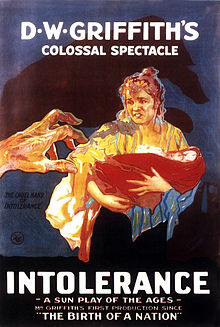
'Eternal Motherhood': a symbolic image of a mother swinging her child that was used in the film to connect the different ages 

However, despite it surely was a major innovation at that time, people, unprepared for such a level of complexity, didn't get the message and, contrary to Griffith's previous movie, 'Intolerance' became a huge economical failure of which he'd never recover completely.


I did understand the movie. We're now exposed to movies that ask more of us than they did in the 1910s. But even getting the message, it was awfully boring. Mainly because I could only find a version with no background music, but anyway, I found the development of the stories very inconsistent; the Babylon and modern ones extended through almost the entire run of the film while the crucifixion only lasted a few minutes and the French part almost didn't appear at all. This leaves the film with only two major -very long- stories and whereas the modern age one was sort of entertaining and included some romance and last minute rescue scenes that gave tension to the story, the Babylon one was excruciatingly slow and at some points I felt like dying. The only positive point I can find over the rest of the movie is that I found Mae Marsh' performance as a suffering mother her most realistic and convincing one yet.

lunes, 27 de agosto de 2012

'The Birth of a Nation' (D. W. Griffith, 1915)


Title: 'The Birth of a Nation'

Release Year: 1915

Director: D. W. Griffith

Cast: Lillian Gish, Mae Marsh, Henry B. Walthall, Miriam Cooper, George Siegmann.

Plot: The movie explains the story of two families (the Camerons in the South and the Stonemans in the North) and how they struggle during Civil War and posterior Reconstruction-Era. It also narrates the assassination of Abraham Lincoln and the creation of the Ku Klux Klan.

Review: D. W. Griffith has been mentioned and commented extensively in the theoretical part of this research project and with this movie he crowned himself as one of the best directors of his age.

Technically it is a huge achievement; using irising and blurring to introduce and close scenes or managing to make one hundred extras seem one thousand while representing a big battle.

But it also succeeded in the field of story telling; how it used all the techniques that had appeared during previous years all together in one movie to give it a meaning. A lot had happened between Méliès' and Porter's movies and film continuity was a reality. Instead of simple individual shots, we see a real connection between them. Apart from a wide range of techniques to give simbology to the movie, like insert shots. We can add to this cross-cutting, insert dialogues, the utilisation of different points of view (including close shots), flashbacks and the division of the movie in two well-structured parts. Each one of these details made of 'The Birth of a Nation' an elborate movie with a complex structure, where topics like war or romance through the distance are developed.

An example of introducing a scene with 'irising' technique

Huge and epic as it was, it became a huge box-office success, a blockbuster of its time, earning 10 millions on its release year and reaching the 50 two decades after, keeping the title of highest grossing film until 'Gone with the Wind'.

But even if the technical and narrative achievements must be acknowledged, I didn't like many aspects of the movie. To begin with, it's true that even with no spoken dialogues, the background music gives some sort of emotion to the movie, but over its three hours of length, it reaches a point where if you don't stop to have a break, continuing is unbearable. Moreover, the actors' performances are usually unreal and overacted, due to the inability to speak.

But the main reason why I disliked the movie is for its hugely racist interpretation of American history. Black people appear as aggressive and mean. and some events are distorted or inaccurate versions of the historical reality. Intending to glorify and justify its acts, a dramatized creation of the Ku Kux Klan is described as 'necessary' to restore the peace that the 'negros' had destroyed. As an example of its increasing xenophobia, the movie reuses actors whose characters die and paints them so they can play African American parts, sort of amusing if we consider that one of them interpretates Lincoln before his role change.


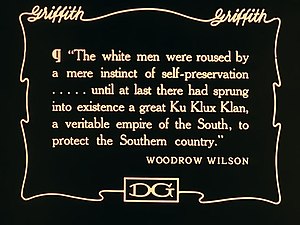
Clear examples of the racist message that the movie wanted to transmit

And that's just something I can't bear. Other achievements aside, the idea it tries to transmit is deplorable, and the fact that it became such a successful hit only demonstrates the ideology of society at that time.

martes, 21 de agosto de 2012

'The Great Train Robbery' (Edwin S. Porter, 1903)


Title: 'The Great Train Robbery'

Release Year: 1903

Director: Edwin S. Porter

Cast: Justus D. Barnes, Broncho Billy Anderson, Alfred C. Abadie.

Plot: As the title says, the movie describes a train robbery performed by an outlaw band and its later capture.

Review: As it happened with George Méliès movie ('Le Voyage dans la Lune'), this is a short. The last one I'll review one, but this time an American one.

Actually, Porter was partly inspired by Méliès work in terms of length and film continuity, an aspect in which he -among other filmmakers of that age- deepened in 'The Great Train Robbery'.

Moreover, the film also used a series of innovative movie techniques which made of it an outstanding achievement at that time: cross-cutting between scenes, more complex editing or camera movement between others. It also had hand-coloured parts (although, in my opinion, it's quite poorly done).

In terms of my personal opinion it's really hard to say when a movie doesn't last more than 10 minutes, but as always, I appreciate Porter's efforts to explain a consistent and logically structured story and although it can't really be said it's an entertaining one, that effort can't be denied.

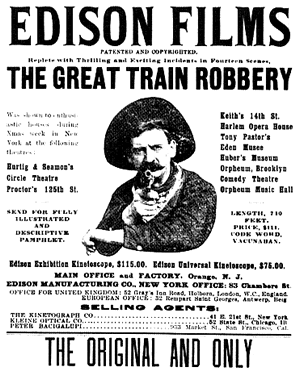
The film famous final shot where the leader of the band shots directly at the screen, causing a major impact in the viewers

sábado, 18 de agosto de 2012

'Le Voyage dans la lune' / 'A Trip to the Moon' (George Méliès, 1902)


Title: 'Le Voyage dans la lune' / 'A Trip to the Moon' 

Release year: 1902

Director: George Méliès

Cast: George Méliès, Jeanne d'Alcy, Bleuette Bernon.

Plot: The film shows the preparation and posterior trip to the Moon in which a number of astronomers participate. After landing and struggling against difficultives (they're attacked and captured by moon natives, the 'selenites'), they are able to escape and return to the Earth safe.

Review: That will be, almost certainly, the Only non-american movie I will review, just as an example of how cinema was at its early beginning back on its native country, France.

Of course we had seen other movies before, but 'Le Voyage dans la lune' will be remembered as one of the first attempts to tell a complete story, even if it only lasted 14 minutes.

This, as commented in the theoretical part of the project, was thanks to the pioneer George Méliès. He created one of the most technically innovative movies of his time, both in black and white and in hand-colored versions. And despite we can consider the special effects quite poor now, it’s almost magical to see how he struggled to find a way to explain a story (in that case, flying to the moon) and how beautifully he showed us that imagination could take us as far away as we wanted, even more than 100 years ago.
That way, it’s almost impossible not to feel caught by his dreamy illusion, a science-fiction tale with (nowadays) a very common storyline, but that, back at the beginning of the century, was a piece of pure imagination and “magical” techniques, becoming one of the most important and remembered movies of cinema's first years.

The iconic image of a rocket crashing into the Moon's eye
¡Recomienda este blog!