Latest Reviews

Mostrando entradas con la etiqueta Charlie Chaplin. Mostrar todas las entradas

jueves, 13 de septiembre de 2012

'The Great Dictator' (Charlie Chaplin, 1940)


Title: 'The Great Dictator'

Release Year: 1940

Director: Charlie Chaplin

Cast: Charlie Chaplin, Paulette Goddard, Jack Oakie.

Plot: Adenoid Hynkel is the tyrannical dictator of Tomania. An unnamed Jew is a once private that now survives as a poor barber in the ghetto. They exist in separate yet not independent worlds that will cross thanks to their big resemblance.

Review: After watching 'Modern Times' (which I liked but not loved due to the proximity with which I had seen previous Chaplin movies), 'The Great Dictator' will be the last Charlie Chaplin film I'll see for this project. Before doing it, the expectations were rather high. Now? They've been completely fullfilled.

There are many reasons why I recall this movie the best of Chaplin that I've seen (even better than 'The Kid'). First, I absolutely loved Hynkel. His dictator is a complex and wonderful creation; emotionally unstable and insecure. I love his agressive attacks in German, and the way he says thousands of things which are just a few words in other languages. There's nothing of him I didn't like. Add to this the hypnotic magic scene he performs when playing with a globe and you'll have a round character.

The fairy score and Chaplin at his finest and best create pure magic

Moreover, that's his first talkie. I wonder why he didn't do any other before. Maybe because he didn't need it; with his star status he could still sell silent pictures and his humour could be fully developed in those. Anyway, his speaking side is also wonderful, thanks to his nice voice and lovely British accent.

What else can be said? Everything mentioned plus his always sweet tramp makes of this film a message of love with plenty of sweetness and fun. After the terror that spreads when the Germans go to the ghetto, that's the final conclusion the film wants to give. Yes, Chaplin put himself in a delicate position with this movie, assotiating his name to politics in a dangerous time, but without that quantity of risk, we would've never been able to see such a beautiful movie. Such a beautiful ending. Such a beautiful message, direct from him to the world and to his beloved Hannah: HOPE.


"Look up Hannah, look up!" Chaplin's best performance to the date concludes with his famous speech

lunes, 10 de septiembre de 2012

'Modern Times' (Charles Chaplin, 1936)


Title: 'Modern Times'

Release Year: 1936

Director: Charles Chaplin

Cast: Charles Chaplin, Paulette Goddard.

Plot: After losing his mind (and his job) over the frantic work life, a workman will have to struggle against the situation instituted by Industrial Revolution, while discovering a beautiful friendship with an orphaned young girl.

Review: One of the things I like the most about Chaplin is his ability to connect with the social problems of society (and how he manages to achieve this while staying silent in sound era ten years after the invention of Vitaphone). After years of higher than normal unemployment numbers, this movie was a clear reflexion of the crazy world they lived in. A world that we still inhabit sometimes.

Every scene of the film is an example of that and of Chaplin's mastery: the sheep's metaphore of workers entering the factory, how they have to deal with all kind of exigences or experiments, how they're treated like one of many who would give anything to work... Chaplin uses all this and a tramp gone crazy to exemplify his modern days situation. As always, we'll see him trying to do everything right but failing miserably with a comedy level only he owns.


Who doesn't remember this iconic scene?

But my favourite parts are, without a doubt, the ones she shares with future real life wife Paulette Goddard. Their strange relationship is a weird friendship between two human beings trying to survive. Endearing, isn't it? Chaplin films always are. And that's perhaps what made him so famous; his ability to make us laugh at the same time that he touched something inside of us. The finest example? The ending (a detail that he controls and beautifies in every movie), features both a beautiful score and one of the topics that you find in more than one of his pictures; hope, giving to the viewer the promise of a better tomorrow.

viernes, 31 de agosto de 2012

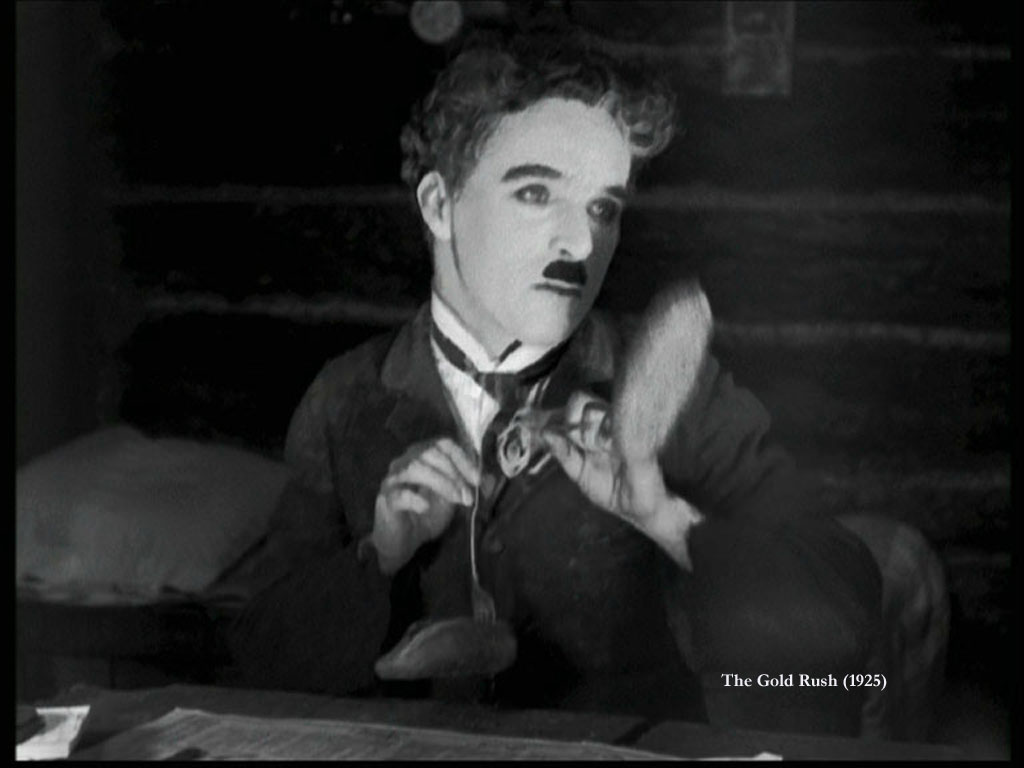
'The Gold Rush' (Charlie Chaplin, 1925)


Title: 'The Gold Rush'

Release Year: 1925

Director: Charlie Chaplin

Cast: Charlie Chaplin, Georgia Hale.

Plot: After going to Alaska seeking for gold at the beginning of the century, The Tramp will find himself in an old cottage of a bandid and falling in love with a saloon girl.

Review: second Chaplin movie I review (and surely not the last), and yet I never get tired of seeing him. It's true that I liked 'The Kid' much more, but any film of his is so endearing that you can't help but want to see another one.

Anyway, this time I found the story led entirely by Chaplin. First he fronts an incredibly funny first part trapped in the cottage with the two other gold-seekers. All by himself he gives warmth to the coldest winter with his lovely yet ingenuous character. Even when we get to the unbalanced love story (he's clearly more into her than she is) it's hard not to see how foolish the protagonist is. I simply love how naive he can be, and who doesn't feel sorry when Georgia plays with his heart? 'The Tramp' owns most of the movie's greatest scenes; him, lonely, standing in front of a happy dancing crowd, the famous 'roll dance'... Funny and sweet, Charlie Chaplin is just a genius of his field.


The aforementioned famous 'roll dance' performed by Chaplin in the movie

That's the reason why I can't entirely be happy when she finally wants to be with him. Yes, at the beginning she doesn't know that he's rich and still wants to help him when the guards try to throw him out of the boat, but later when they kiss she already knows it. It takes a wonderful score and one of the best endings of the Silent Era (seriously, what an ending!) to convince you that her feelings are true and noble.

The heartbreakingly beautiful ending of the movie

jueves, 30 de agosto de 2012

'The Kid' (Charlie Chaplin, 1921)


Title: 'The Kid'

Release Year: 1921

Director: Charlie Chaplin

Cast: Chalie Chaplin, Jackie Coogan, Edna Purviance.

Plot: After a poor London woman abandons her newborn child due to economic difficulties, The Tramp (Charlie Chaplin), adopts him and becomes his new father. Some years later, the woman, now a famous actress full of regrets, starts looking for him.

Review: I had never seen a movie of Chaplin before this one and I had some pretty high expectations. Surprisingly, they were largely fulfilled.

When I first heard about 'Slapstick', the comedy genre in which Chaplin was specialized, I was afraid I would have to face a whole hour of easy jokes and dumb gestures, but when I started watching the movie any previous idea went away.

File:Chaplin The Kid.jpgNot only was the film genuinely funny, but endearing and sweet. With plenty of symbolism, Chaplin created a story full of heart and his performance characterized as the iconic 'Tramp' only made it more special. Every scene where he's with the little kid, has so much magic that it's difficult not to fall in love with his cheerful and somehow naive character, especially the tearful scene they both share when they reunite after the police tries to take the chlld away from him. Exuding the essence of which good classic cinema is made of, 'The Kid' will remain as an ageless film that crowned Chaplin as a real genius of his field.


The iconic image of 'The Tramp' (Chaplin) and The 'Kid' (Coogan) sitting at the entry of their home.
¡Recomienda este blog!