Latest Reviews

Mostrando entradas con la etiqueta 1940s. Mostrar todas las entradas

lunes, 17 de septiembre de 2012

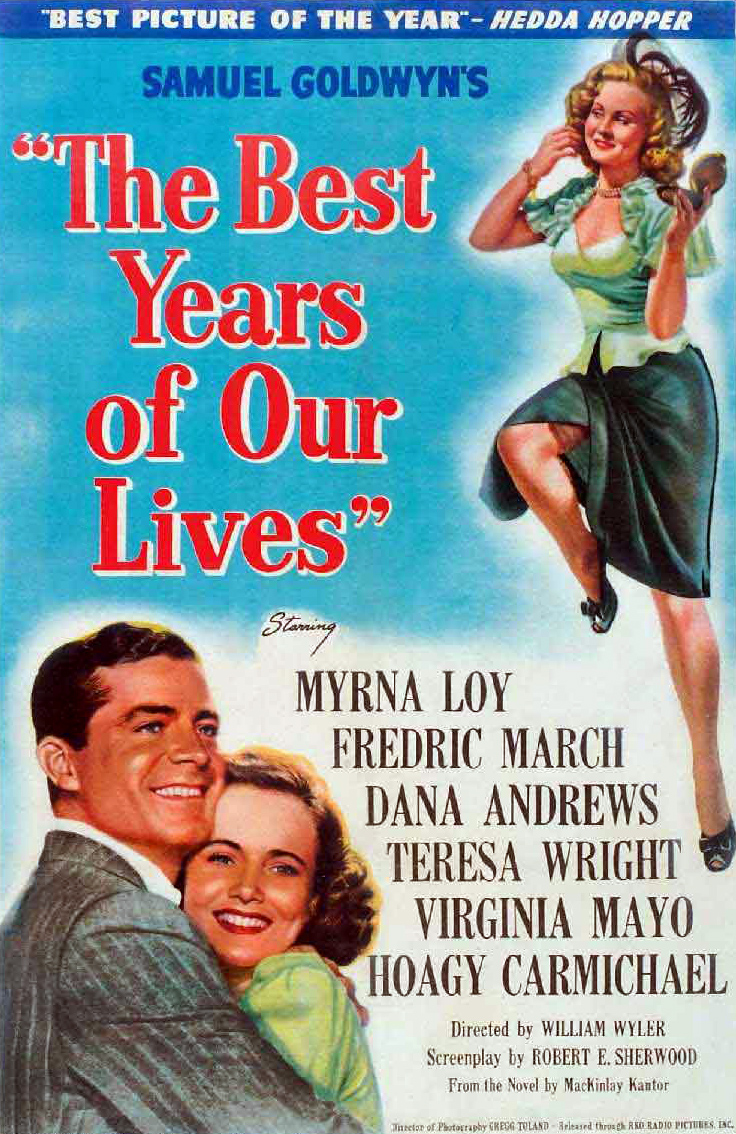
'The Best Years of Our Lives' (William Wyler, 1946)

Title: 'The Best Years of Our Lives'

Release Year: 1946

Director: William Wyler

Cast: Fredric March, Dana Andrews, Harold Russell, Myrna Loy, Teresa Wright, Virginia Mayo and Cathy O'Donnell.

Plot: After returning from war, three soldiers will have to face a society that has changed while they were fighting, for better and or worse.

Review: When I chose this movie, critically acclaimed and a box-office hit of its time, I did it cause I wanted to see a psychological portrait of the scars that war leaves in soldier's minds. 'The Best Years of Our Lives' doesn't quite live to such expectations, but does a nice job, trying to explain the thought adaptation of its three leading characters.

Each of them has compelling stories; from the day to day technical problems of losing both hands, to the return home to a society that has forgotten that you fought for them and in which you must keep doing a low profile job to maintain yourself economically.

The well-casted leading men

March, Andews and Russell (who was a real life amputee) are at their best portraying each of them, creating compelling actors with thought-provoking stories. My only complain might be the tendency to patriotism and happy endings that drowned movies those days, especially for the cheesy performance of Cathy O'Donnell, which spoils the love story of her character with Harold Russell's one, something that doesn't happen with the beautifully constructed relationship of Captain Fred Derry and Peggy Stephenson.

It isn't a proper Hollywood ending if it hasn't got a good final kiss for the love story, is it?

domingo, 16 de septiembre de 2012

'Casablanca' (Michael Curtiz, 1942)


Title: 'Casablanca'

Release Year: 1942

Director: Michael Curtiz

Cast: Humphrey Bogart, Ingrid Bergman, Paul Henreid, Claude Rains.

Plot: In the heat of the World War II, Casablanca was a traverse city that was used to arrive to Portugal, and then to America. But for Rick Blaine and Ilsa Lund it's the place where they recover and lose a love estranged by war time.

Review: Hollywood's Goledn Age love story. And maybe the most important of all cinema history. Casablanca will always be remembered as the smoky town which saw the impossible love of Bogart and Bergman.

To understand this review is very important watching the movie first. If you don't do it, you won't see what makes people love this movie. And that is the film itself. The story on its own is beautiful, yes. And the characters live their love while fighting agains the circumstances. He plays the tough man role while the past hits him when she arrives by the hand of another man, secretly still in love with him and with her heart split between heading to America or staying. That's the kind of love story people falls in love with, even with his coldness and her lack of directive, but it's not what finally hits you, at least, not after having watched it and recalled it, which is what it's done with good classic cinema.

Humphrey Bogart and Ingrid Bergman as lovers stranged by war, in their mysterious yet romantic characters

What hits you is the atmospheare; everything that sorrounds casablanca is impregnated with it; a melancholic yet powerful feeling of watching the love story of a lifetime. It intoxicates you and no matter how things may turn, you end up being absorved by the story.

Its a difficult feeling to explain, as many other created by good cinema, but when you think of the film and recall 'As the time goes by' in you head, you can't heap but feeling a weird sensation, this iconic, classic, smoky sensation that the picture spreads throught its whole run.


"Play it, Sam. Play 'As Time Goes By'"

That's Casablanca. And its iconic scenes, and its quotes ('Louis, I think this is the beginning of a beautiful friendship' has transitioned to popular culture, for example, marking the bond between Bogar and Rains' character's). That's why it remains as Golden Age's love story, because its the tragic love that stayed in the city when she left and was tied to its essence. An impossible one, tied forever with film history as Bogart pronounced his famous words, after all, We'll always have Paris.


Bogart and Bergman's farewell is still remembered as one of cinema's most famous and beloved scenes

sábado, 15 de septiembre de 2012

'Citizen Kane' (Orson Welles, 1941)


File:Citizenkane.jpg
Title: 'Citizen Kane'

Release Year: 1941

Director: Orson Welles

Cast: Orson Welles, William Alland, Ray Collins, Dorothy Comingore, Joseph Cotten.

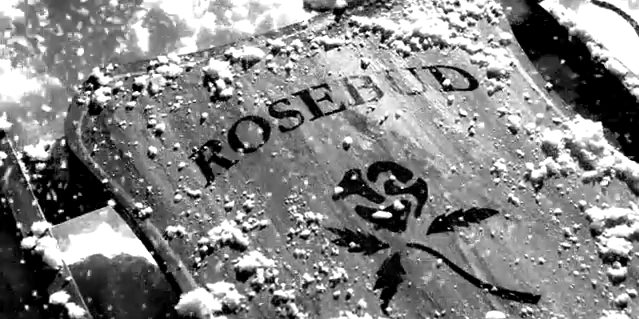
Plot: An important business man, Charles Foster Kane, dies in Xanadú, his oriental style castle. His last word - Rosebud - generates enormous curiosity and leads a group of journalists to investigate his life in order to solve the mysterious enigma.

Review: Named several times as the best movie of all time, Citizen Kane was world reknown for its innovation in story telling structure. But what does this exactly mean?

Well, summing up, the film was praised for using three characters, each one connected to a part of Kane's life and, by flashbacks, explaining the story from the beginning to the end, that is, from the past to the present. Some may ask: that's all? That's all it takes to reach the 1st position in cinema rankings? Well, there are two things that must be added to the explanation. The first one is that we are at the beginning of the 40s. Hollywood has imposed the lineal story as a way to attrack audiences to the theatres, there's no need to complicate things. Welle's picture was a glowing star in the middle of the already golden age, showing us that other ways were possible.

The second one is how flawless the structure was. Even if now it's not that strange and new filmmakers have created more complex structures, the film is so well constructed that the story just flows through it without a single trouble. The timing, the sections; all is calculated to result in perfect harmony.

'Citizen Kane' had a revolutionary story-telling

And then there's the mystic enigma. "Rosebud". I admire how with a simple word they're able to catch the audience so much. That's the key of good movies; they give you reasons to love the movie even before you've ended watching them. As the film goes by and the performances consolidate with it, the mystery just rises and rises, rising the movie with it. It's infallible, reaching the end with the spectator biting his nails.

At the end, it's always very hard to meet the expectations, but 'Citizen Kane' surprisingly does. While I had accepted the theory that the enigma was a missing part in Kane's life, a piece that just didn't exist I was very surprised when I saw the name 'Rosebud' printed in his chilhood sled (suddenly understanding why he died while holding a snow globe). That had been missing, his childhood: money made him buy everybody and everybody's love; money spoiled him. All he ever wanted was to be a normal kid with his family and a sled to play when it snowed. That's the final trick; we're so focused on following the marks of a mystery left accidentally, the facts of the exterior persona, that we don't realize that it was his subconscious that left the hint; a key that could lead someone to see his buried cry for help, a cry lost in time as his sled was.


Film history most famous enigma was infact the lost chilhood of a spoiled, yet lonely, old man. A final scream to go back to the past

viernes, 14 de septiembre de 2012

'The Philadelphia Story' (George Cukor, 1940)


File:The-Philadelphia-Story-(1940).jpg
Title: The Philadelphia Story

Release Year: 1940

Director: George Cukor

Cast: Cary Grant, Katherine Hepburn, James Stewart, Ruth Hussey.

Plot: As Tracy Lord and George Kittredge are getting married, journalists Macauley Connor and Elizabeth Imbrie attend the wedding, where the most unbelieveable sort of things happen.

Review: After the last remarkable and transcendental films, this one surely may seem a stop in the road, and maybe it is, but the presence of Hepburn in any movie makes of it a worth watching one.

If asked for a characteristic that defines 'The Philadelphia Story' better than any other, that is, without a doubt, its weird humour. This kind of uncomfortable sudden lines thrown by the characters (mainly by Ruth Hussey, my favourite supporting one) that splash the film as it moves on towards the wedding.

File:Philadelphia Story 19.jpg
Ruth Hussey gives an outstanding performance as Elizabeth Imbrie

In such a turmoil, with the frantic wedding coming closer and closer, a leading figure that leads the film is essential. That is, of course, the wonderful Katherine Hepburn, who gives here a secure and powerful performance, where she demonstrates her strong presence. Her character is a dreamy 'goddess' (as named in the picture) who controls the situation as much as she's able to, in every aspect except in her own persona, where she's lonely and afraid of her own power. Why is she not happy when her husband-to-be names her as that goddess? Well, that's the main topic which is unfold trhough the movie and fully developes at the very end.

There was and will ever be no one with the presence on screen of Katherine Hepburn. After some box-office bombs in the 30s, she's said to have recovered her career with this film

The reason is the one that makes Tracy not marry his fiancé, or Macauley when he asks her to. And the same one that makes her fall in her ex-husband arms again; she goes back with him because he's the only one that doesn't adore her as a goddess but loves her as a human being. That's why she's so afraid yet attracted to him; in a world where the light of the spotlight is everywhere for her, he's the only one capable to see not only her powerful outside but his vulnerable inside.

jueves, 13 de septiembre de 2012

'The Great Dictator' (Charlie Chaplin, 1940)


Title: 'The Great Dictator'

Release Year: 1940

Director: Charlie Chaplin

Cast: Charlie Chaplin, Paulette Goddard, Jack Oakie.

Plot: Adenoid Hynkel is the tyrannical dictator of Tomania. An unnamed Jew is a once private that now survives as a poor barber in the ghetto. They exist in separate yet not independent worlds that will cross thanks to their big resemblance.

Review: After watching 'Modern Times' (which I liked but not loved due to the proximity with which I had seen previous Chaplin movies), 'The Great Dictator' will be the last Charlie Chaplin film I'll see for this project. Before doing it, the expectations were rather high. Now? They've been completely fullfilled.

There are many reasons why I recall this movie the best of Chaplin that I've seen (even better than 'The Kid'). First, I absolutely loved Hynkel. His dictator is a complex and wonderful creation; emotionally unstable and insecure. I love his agressive attacks in German, and the way he says thousands of things which are just a few words in other languages. There's nothing of him I didn't like. Add to this the hypnotic magic scene he performs when playing with a globe and you'll have a round character.

The fairy score and Chaplin at his finest and best create pure magic

Moreover, that's his first talkie. I wonder why he didn't do any other before. Maybe because he didn't need it; with his star status he could still sell silent pictures and his humour could be fully developed in those. Anyway, his speaking side is also wonderful, thanks to his nice voice and lovely British accent.

What else can be said? Everything mentioned plus his always sweet tramp makes of this film a message of love with plenty of sweetness and fun. After the terror that spreads when the Germans go to the ghetto, that's the final conclusion the film wants to give. Yes, Chaplin put himself in a delicate position with this movie, assotiating his name to politics in a dangerous time, but without that quantity of risk, we would've never been able to see such a beautiful movie. Such a beautiful ending. Such a beautiful message, direct from him to the world and to his beloved Hannah: HOPE.


"Look up Hannah, look up!" Chaplin's best performance to the date concludes with his famous speech
¡Recomienda este blog!